
Gen Z VCs Are Writing the Checks: The Standouts, Ages and Track Records
TL;DR
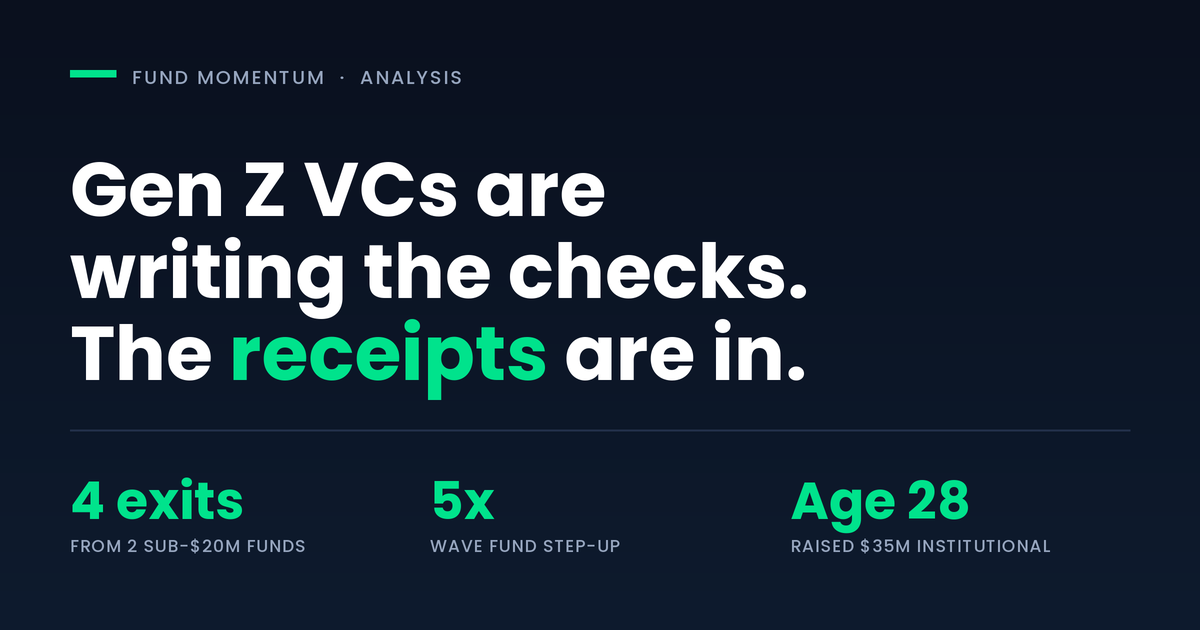
A new generation of venture capitalists has stopped waiting for permission. Gen Z GPs, several of them not yet 30, are closing institutional funds, posting real exits, and getting in early on category-defining companies. This is not a story about potential. Animal Capital has already returned capital through four strategic exits. Meridian Ventures manufactured a track record across 45 companies before raising an oversubscribed institutional debut. Wave Ventures earned a fivefold fund step-up. These investors grew up inside the creator economy, social distribution and AI-native products, and that native fluency is turning into fund performance. Here is who stands out, and why.
Key Takeaways
The track records are real, not promised. Animal Capital has produced four strategic exits from two sub-$20 million funds: Saturn to Snapchat, Deliverr to Shopify, Inkbox to BIC and Stage10 to eBay. That is realised DPI, not paper markups, and it is exactly the evidence that de-risks a young manager for institutional LPs.
Age is the edge, not the handicap. These GPs did not study community-led growth, creator distribution or AI-native product from a deck. They came up inside those systems. When the fastest-growing consumer generation in history starts product searches on TikTok, the investors who natively understand that behaviour have a sourcing and judgement advantage that pattern-matching incumbents cannot easily replicate.
The step-ups signal genuine LP conviction. Wave Ventures jumped 5x from €2 million to €10 million. Animal Capital's Fund III at $33 million is larger than Funds I and II combined. Fund sizes grow like that only when limited partners have seen the model work and want more of it.
They are already on the best cap tables. Early entries include Whatnot, Colossal Biosciences, Whop and Underdog through Animal Capital; Clara, Italic, Wander and Sanas through Adapt Ventures; and OpenAI, Anduril, SpaceX and Cognition through Anti Fund. This cohort is getting into category winners at the earliest priced rounds.
What Makes This Generation Different
Venture capital has traditionally rewarded seasoning: an elite pedigree, years of apprenticeship, a slow climb from analyst to partner. The implicit assumption was that judgement about markets requires distance and experience. For most of the history of the asset class, that was broadly true.
It is far less true when the market in question is one you grew up inside. The strongest Gen Z investors did not learn about the creator economy, social commerce, community-led growth or AI-native products by reading about them. They lived them as users, and in many cases as operators, before they ever wrote a cheque. That fluency compresses the diligence loop. Where an older partner needs a research memo to understand why a TikTok-native acquisition motion works or why a Discord community is a moat, this generation reads it instantly, because they have been on both sides of it since adolescence.
That advantage is most valuable at exactly the point where it is hardest to fake: the earliest stage, before there is revenue to model or a comparable to reference. Sourcing the next exceptional consumer founder, and having the cultural credibility to win that allocation against a bigger brand, is a game where being 27 and deeply networked into a scene beats being 47 and reading about it. The numbers below suggest the market is starting to price that in.
The Standouts
Anti Fund, the largest of the cohort. Co-founded by Jake Paul, who was born in January 1997 and sits in the first year of Gen Z, alongside Geoffrey Woo, with Logan Paul as general partner. Anti Fund Growth I closed at $100 million, lifting firm AUM past $180 million. The growth book already holds OpenAI, Anduril, SpaceX and Cognition, which is remarkable access for a young platform. The lesson others are studying: a creator brand converted genuine audience and attention into late-stage allocation that money alone cannot buy.
Meridian Ventures, the cleanest emerging-manager playbook of the year. Founded by Devon Gethers, 29, and Karlton Haney, 28, both 2025 Harvard Business School graduates. Rather than lead with credentials, they raised a $2.5 million proof-of-concept vehicle, deployed it across 45 companies to build a verifiable track record, then converted that into an oversubscribed $35 million institutional debut backed by publicly traded banks, family offices and Fortune 500 executives. Check sizes are $500,000 at pre-seed and $750,000 at seed. It is the most credentialed Black-led emerging-manager close of 2026 so far. Note this is a distinct firm from the $25 million Meridian vehicle run by Rex Woodbury's Daybreak; the two are frequently confused.
Animal Capital, the exit machine. Founded in 2020 by Marshall Sandman with TikTok creators Josh Richards, Griffin Johnson and Noah Beck as operating partners. Fund III closed at $33 million, larger than the $13 million Fund I and $16 million Fund II combined. The disciplined step-up is the point: plenty of creator-era funds raced to $100 million and broke their model, while Animal Capital stayed in genuine seed territory where a single outcome returns the fund. The portfolio counts Whatnot, Colossal Biosciences, Whop and Underdog, and the exits are already booked.
Adapt Ventures, the operator-founders. Brothers Ammar and Mohammed Amdani, who were 25 and 23 at founding, run roughly $30 million in AUM. Before Adapt they built and exited a direct-to-consumer womenswear brand called Sugar while at NYU, which is why their diligence is founder-empathetic by construction. Early backers of Clara, now a unicorn, plus Italic, Wander and Sanas. This is the closest thing the cohort has to a conventional early-stage franchise, built by people who were founders first.
Wave Ventures, Europe's age-capped experiment. Helsinki-born and run entirely by investors aged 25 and under on a rotating basis, a decade after starting as a student-led initiative in 2016. Fund III closed at €10 million, a fivefold jump from its €2 million predecessor, writing cheques up to €300,000 across 10 to 20 companies a year, plus a €240,000 equity-free Wave Rebellion Grant for pre-idea founders. Its LP base reads like a Nordic operator hall of fame: Spotify, Wolt, Slack, Bolt, Supercell, Oura, Nokia and Voi.
Behind Genius Ventures, the storytelling thesis. Paige Finn Doherty, 25 at her Fund II close, raised an $8.9 million second fund writing $150,000 to $250,000 cheques with an explicit focus on backing the best founder storytellers. She is on Fund II before many of her peers have raised a first institutional vehicle.
The next names. CiCi Bellis, 26 and a former professional tennis player, is managing partner at Cartan Capital. Jules Deplanck co-founded Genesis Fund and wrote his first cheques before graduating. Both are early in their fund journeys but already deploying.
The Receipts: Track Record and Multiples
The most important thing to understand about this generation is that the case no longer rests on narrative. There is a growing body of hard evidence.
On realised outcomes, Animal Capital is the standout: four strategic exits, Saturn to Snapchat, Deliverr to Shopify, Inkbox to BIC and Stage10 to eBay, all from funds of $13 million and $16 million. Four exits from two sub-$20 million vehicles is a genuine DPI story, and it is the single most persuasive data point in the entire cohort because it is cash, not carrying value.
On fund trajectory, the step-ups tell their own story. Wave Ventures multiplied its fund size fivefold, from €2 million to €10 million, which happens only when LPs are convinced the engine works. Animal Capital tripled across three funds while deliberately staying small enough to keep its model intact. Anti Fund built past $180 million in AUM across a barbell of earliest-stage and growth vehicles.
On the path itself, Meridian Ventures is the cleanest case study in venture right now. Two founders in their late twenties built a $2.5 million proof-of-concept fund, deployed it across 45 companies to generate a verifiable track record, and converted that into an oversubscribed institutional close. That is the emerging-manager playbook executed to the letter, at an age when most of their peers are still associates. And on entry quality, the cohort's collective portfolio, from Whatnot and Colossal to Clara and OpenAI, shows a group getting onto the best cap tables at the earliest priced rounds.
What They're Backing
The sector concentration is consistent and it maps precisely onto where this generation has native insight: consumer and creator economy, fintech, community-led and mobile-first brands, and AI-native products. Animal Capital's Whatnot, Whop and Underdog are all social-commerce and community-native businesses. Adapt's Clara, Italic and Wander sit at the intersection of consumer and marketplace. Anti Fund's growth book leans into frontier infrastructure with OpenAI, Anduril and SpaceX. Behind Genius indexes on founder narrative. Wave leads the youngest Nordic pre-seed rounds before anyone else is in the room.
The through-line is that these are not generalist funds chasing whatever is hot. They are concentrated bets in categories where the GPs' lived fluency is a genuine underwriting edge, which is why the early entries keep landing on companies that go on to matter.
The Community Engine
Behind the individual funds sits an unusual amount of collective infrastructure, and it starts with Meagan Loyst. She founded Gen Z VCs as a Slack group in November 2020 and has grown it into a global community of more than 32,000 investors and founders across over 80 countries. It is now the single largest concentration of young-investor deal flow anywhere, a Forbes 30 Under 30 honoree's side project that became a genuine ecosystem. Loyst herself never had to raise a fund to accumulate real influence over how this generation sources and shares deals.
The demographics of the cohort are worth stating plainly, because they are a strength. On the Forbes 30 Under 30 venture capital list for 2026, 58% of those named identify as people of colour and 48% as women, a profile dramatically more diverse than the partner ranks of established firms. This generation of investors looks more like the founders and the consumers they serve than any that came before it, and in consumer and community markets that representativeness is itself an edge.
What This Means for Founders
If you are raising pre-seed or seed in consumer, creator economy, community-led commerce, fintech or AI-native products, this cohort is some of the highest-signal early capital available to you. You will not spend the meeting explaining why your TikTok acquisition motion works or why community engagement matters more than paid CAC. The understanding is already there, which means faster conviction and a partner who can actually help rather than just fund.
The added value is distribution and access. A consumer company on Animal Capital's cap table sits one degree from MrBeast and Paris Hilton; a Nordic company backed by Wave sits one degree from the operating benches of Spotify, Wolt and Supercell. For an early consumer startup, that network is frequently worth more than the cheque itself. And as the original observation goes, most of these investors are one direct message away, with none of the associate-gated inbound that slows down a raise at a larger firm. Size the cheques realistically, build the syndicate around them, and treat this as the smartest first money in your category.
Fund Momentum Take
Our view is that this is one of the most genuinely exciting structural shifts in early-stage venture, and it is still early. The pattern that matters is not that young people are raising funds, it is that the best of them are pairing native market fluency with real discipline and, increasingly, with realised returns. Animal Capital's four exits, Meridian's proof-of-concept-to-institutional path, and Wave's fivefold step-up are not lucky breaks. They are evidence of a repeatable edge being converted into performance.
The discipline point deserves emphasis because it is what separates this wave from the 2021 creator-fund froth. The funds that are working stayed small on purpose. Animal Capital's decision to keep Fund III at $33 million rather than chase a $100 million headline is precisely why a single Whatnot-scale outcome can still return the fund. Small, concentrated and deeply networked is not a limitation for a seed strategy, it is the optimal shape of one, and this cohort largely understands that better than the megafunds do.
Our bet is that two or three of these firms cross $150 million in AUM within five years on the back of realised exits, and that the standout GPs of this generation become the brand-name partners of the next. The advantages compound: the earlier you build genuine standing inside the communities that produce the next consumer and AI-native founders, the more durable your sourcing edge becomes. This generation started building that standing before they turned 30. We would take that bet every time.
Frequently Asked Questions
Who are the standout Gen Z venture capitalists in 2026?
Names getting attention include Jake Paul and the team at Anti Fund, Devon Gethers and Karlton Haney at Meridian Ventures, Marshall Sandman and the creator partners at Animal Capital, Ammar and Mohammed Amdani at Adapt Ventures, the under-25 team at Wave Ventures, and Paige Finn Doherty at Behind Genius Ventures. Meagan Loyst anchors the ecosystem through the Gen Z VCs community.
Do Gen Z VCs have real track records?
Increasingly, yes. Animal Capital has produced four strategic exits, including Saturn to Snapchat and Deliverr to Shopify, from funds of $13 million and $16 million. Wave Ventures earned a fivefold fund step-up. Meridian Ventures built a track record across 45 investments before raising institutionally. These are realised outcomes and demonstrated LP conviction, not just markups.
What do Gen Z VCs invest in?
Predominantly consumer and creator economy, fintech, community-led and mobile-first brands, and AI-native products, the categories where growing up inside the market is a genuine underwriting advantage. Early portfolio entries span Whatnot, Colossal Biosciences, Whop, Underdog, Clara, Italic, Wander, Sanas, OpenAI, Anduril and SpaceX.
How young are these fund managers?
Under the Pew Research Center definition, Gen Z is those born in 1997 or later, so the oldest members turned 29 in 2026. Devon Gethers is 29, Karlton Haney is 28, Paige Finn Doherty was 25 at her Fund II close, and the Amdani brothers were 25 and 23 when they founded Adapt. Wave Ventures caps its entire investment team at 25 by design.
How can founders reach Gen Z VCs?
Directly, in most cases. This cohort is known for accessibility and fast decisions, and many are active in the 32,000-member Gen Z VCs community founded by Meagan Loyst. For consumer or creator-economy founders in particular, they offer both capital and access to creator and operator networks that function as distribution.
Have a fund closing to announce? Submit your fund here.
Need help raising capital? Check out our Fundraising Advisory services.
Related funds in the index
Creator Economy funds from the verified index
| Fund | Size | Stage | Location | Focus |
|---|---|---|---|---|
| Animal Capital Fund III | $33M USD | Seed | United States | Consumer & Commerce, Creator Economy +2 |
| Runway Ventures Fund | $10M USD | Pre Seed | United States | AI/ML, Creator Economy |
| Solaire Partners IPTV Video Investment Fund I | $28M USD | Seed | South Korea | AI/ML, Creator Economy +2 |
| Goalhanger Ventures | — | Seed | United Kingdom | Creator Economy, Consumer & Commerce |
| Weekend Fund IV | — | Pre Seed | United States | AI/ML, Consumer & Commerce +2 |