Bessemer Venture Partners Raises $5.75B for AI Bets
TL;DR
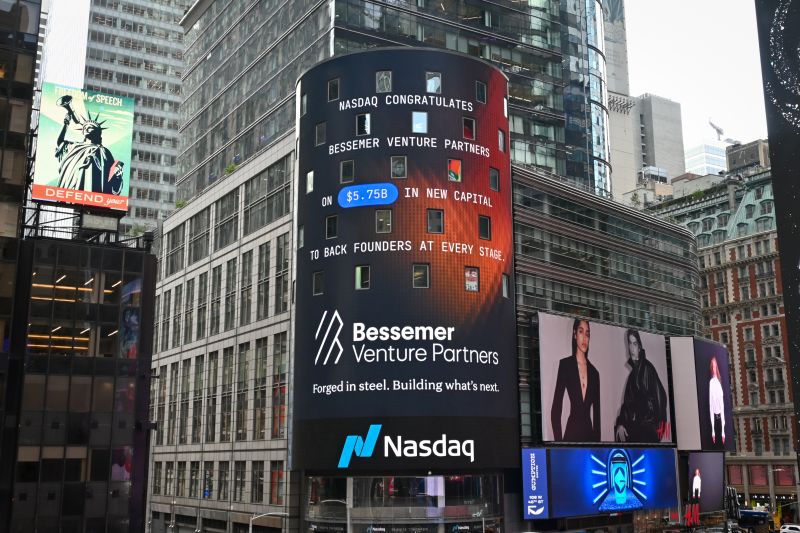
Bessemer Venture Partners has raised $5.75 billion in a single close across two vehicles: $1.75 billion for seed and early-stage investing and $4 billion for growth, the firm announced on September 23, 2026. It's Bessemer's largest capital raise since its 2022 close ($3.85 billion for BVP XII plus $780 million for BVP Forge, totaling $4.6 billion), and the money is earmarked overwhelmingly for AI-native companies across the full stack, from compute and infrastructure through foundation models, developer platforms, applications and agents. It matters because Bessemer isn't a momentum shop chasing a hot sector for the first time. This is a 115-year-old institution with $20 billion in AUM and 155+ IPOs on its scorecard reallocating serious capital toward a thesis it's already backed with $3 billion and 260+ AI-native companies since 2022, and the growth vehicle's size relative to its 2022 predecessor tells you exactly where Bessemer thinks the durable value in this cycle will accrue.
Key Takeaways
The growth vehicle nearly quintupled while the early-stage fund barely moved. In 2022, Bessemer's later-stage vehicle, BVP Forge, closed at $780 million, built explicitly for management teams "seeking liquidity" as companies stayed private longer. Four years later, the growth vehicle is $4 billion, more than five times the size, while the early/seed allocation moved from $3.85 billion to $1.75 billion (a smaller number, though the two funds aren't structured identically, so a direct apples-to-apples comparison isn't possible from what's been disclosed). The dollar-weighted center of gravity has shifted hard toward growth.
"70% of investments go to early stage" is a deal-count stat, not a dollar stat, and the distinction matters. Bessemer's own announcement says roughly 70% of investments are directed at early-stage companies, but the growth vehicle ($4 billion) is more than double the early-stage vehicle ($1.75 billion) in raw capital. Elliott Robinson, a Partner on Bessemer's Growth team who joined the firm in 2019, made the same point directly in his own LinkedIn announcement of the raise: despite how much the Growth practice has scaled under him, "70% of Bessemer investments are early stage and with the pace of innovation today, those Founders will always be our core focus and foundation." That's a Growth partner himself confirming early stage isn't being deprioritized just because the growth vehicle is larger in dollars, it's a volume-of-deals story, not a shift in institutional priority.
The thesis is the full AI stack, not just applications. Bessemer is explicit that it's targeting "compute and infrastructure, foundation models, developer platforms, and AI applications and agents," and its own portfolio list backs that up: infrastructure and dev-tooling names like Fireworks and ChipAgents sit next to applied AI companies like Abridge (healthcare documentation) and EliseAI (property management automation). That's a deliberately un-narrow bet, which cuts both ways: it maximizes surface area for winners but also means Bessemer is exposed to valuation resets across every layer of the AI stack simultaneously if sentiment turns.
Bessemer didn't name the new funds, and that's a break from precedent. The firm's 2022 raise was explicitly branded: BVP XII (its twelfth flagship early-stage fund) and BVP Forge. The September 2026 announcement describes the $1.75 billion and $4 billion allocations without giving either vehicle a fund name or number. That's a small thing, but for a firm that has historically been transparent about its fund lineage and vintage numbering, the omission is worth flagging rather than assuming a "BVP XIII" exists until Bessemer confirms it.
Fund Overview
Fund Name: Not formally disclosed in Bessemer's announcement; referred to as its new seed/early-stage vehicle ($1.75B) and growth vehicle ($4B)
Fund Size: $5.75 billion combined, raised in a single close (announced September 23, 2026)
Stage: Seed through growth; 70% of investments (by deal count) at early stage, per Bessemer Growth Partner Elliott Robinson
Check Size: Not disclosed
Geography: Global, with disclosed investments across the US, Europe, India and Israel
Focus: AI-native companies across the full stack, compute/infrastructure, foundation models, developer platforms, applications and agents
Key LPs: Not disclosed
Why This Fund Matters
Bessemer is one of the oldest continuously operating venture firms in the US, tracing its roots to 1911, when Henry Phipps Jr., a co-founder of Carnegie Steel, spun the family office Bessemer Securities out of Bessemer Trust to make riskier private investments alongside the family's more conservative holdings. That history matters context-wise: this isn't a firm reinventing itself for AI hype, it's a century-old capital allocator whose entire institutional memory is built around correctly identifying which industrial-scale technology shifts are durable and which aren't (the firm famously passed on Google, Facebook, Airbnb, PayPal and eBay, and has been publicly self-deprecating about it, which at least suggests a willingness to learn from misses).
The size and structure of this raise says as much about the state of the AI venture market as it does about Bessemer specifically. A $4 billion growth vehicle, deployed by a firm with the balance sheet and reputation to get into oversubscribed rounds, is a direct bet that the current generation of AI infrastructure and application winners (the firm names Anthropic, Cognition, ClickHouse and Waymo among its growth-stage holdings) will keep needing large primary and follow-on checks to stay private rather than go public. That's consistent with the broader "staying private longer" trend that's defined late-stage VC and growth equity for the past several years, but $4 billion is a meaningfully larger bet on that trend continuing than Bessemer's $780 million Forge vehicle was in 2022.
On the early-stage side, a $1.75 billion fund spread across a high volume of seed and Series A checks is Bessemer signaling it still wants first-mover access to the next generation of AI-native founders before they're growth-stage-priced. The named early portfolio, Abridge, ChipAgents, fal, Noda, Perceptron, Plenful, TurbineOne and Wonderful, spans healthcare AI, developer infrastructure, robotics-adjacent hardware and vertical automation, which is a broader early-stage net than a firm chasing a single narrow AI sub-thesis would cast.
The competitive context is worth naming plainly: this raise lands in a year when several other large multi-stage platforms (a16z's Growth Fund V at $8.5 billion and its Machine Age Fund at $1.1 billion, Bain Capital Ventures' ~$1.6 billion AI vehicle) have all announced comparably AI-concentrated capital in 2026. Bessemer's $5.75 billion doesn't make it the largest AI-focused raise of the year, but it does confirm that the biggest, oldest venture brands are converging on the same structural answer: raise bigger growth capital, keep early-stage access alive, and concentrate almost all of it on AI.
The Team
Bessemer's announcement was attributed to the firm rather than a single General Partner, consistent with its structure of 27+ partners across offices rather than a small founder-led GP group. Three partners have gone on record about the raise. Jeremy Levine, who has been one of the firm's most visible growth-stage voices for years (he led Bessemer's early bet on Shopify, among others, and was also quoted on the firm's 2022 raise), framed the new capital around continuing to "identify transformative technology shifts early and back exceptional founders." Byron Deeter, Bessemer's longtime cloud and enterprise-software partner, tied the raise directly to velocity in the market, noting that AI-native companies are scaling faster than any category the firm has backed. And Elliott Robinson, a Partner on Bessemer Growth who joined the firm in 2019, posted his own reflection on LinkedIn, crediting the growth team's maturation over his tenure while explicitly thanking Bessemer's Limited Partners for what he called "a once in a career opportunity to invest at this unique time in human history." All three are confirmed current Partners per Bessemer's own team page; the firm does not use a "General Partner" title distinct from "Partner" in its public team listing, and it also lists a smaller number of dedicated Venture Partners and a Partner Emeritus (Felda Hardymon), a structure worth noting so as not to conflate the two.
Early Portfolio
Bessemer's own announcement ties specific, named portfolio companies to each side of the new capital. On the early-stage side: Abridge (AI medical documentation), ChipAgents (chip design AI), fal (generative media infrastructure), Noda, Perceptron, Plenful (healthcare workflow automation), TurbineOne (edge AI for defense/industrial use) and Wonderful. On the growth side, the firm names Anthropic, ClickHouse, Cognition, EliseAI, EvenUp, Fireworks, HiBob, Legora, MaintainX, Saronic and Waymo, alongside a broader growth book that separate reporting on the firm ties to Canva, LinkedIn, Perplexity, Pinterest, Ramp, Rocket Lab, ServiceTitan, Shopify and Toast. It's a genuinely wide book by sector (defense tech, legal AI, healthcare, developer infrastructure, robotics, fintech, enterprise SaaS), which is either a strength (diversified exposure to the AI shift regardless of which vertical wins biggest) or a risk (correlated drawdown if AI valuations broadly reset), depending on how the next 18 months of AI monetization actually plays out.
What This Means for Founders
If you're building anything AI-native, infrastructure, applications or agent tooling, and you're at seed through Series A, Bessemer's $1.75 billion vehicle means the firm has fresh, dedicated early-stage capital and an explicit mandate to deploy it broadly across the stack rather than into one narrow sub-thesis. The named early bets (healthcare AI, chip-design AI, generative media infra, defense-adjacent edge AI) suggest Bessemer's early-stage screen is thesis-driven but not sector-dogmatic, which is worth knowing before you pitch: come in with a clear point of view on why your layer of the stack compounds, not just an "AI-native" label. For later-stage founders weighing a large primary or secondary round to stay private, the $4 billion growth vehicle is a real, disclosed signal that Bessemer has the check size to lead or anchor growth rounds at scale right now, and its stated preference is for AI-native companies that are already demonstrating the kind of hypergrowth the firm cites (its language is explicitly "scaling faster than any category we've backed"). If you're not AI-native but are otherwise a strong growth-stage business, this fund's stated focus suggests you may get less attention from Bessemer specifically than you would have five years ago; that's not a knock on the firm, just an honest read of where its capital is now concentrated.
Fund Momentum Take
The most interesting fact in this raise isn't the $5.75 billion headline, it's the shape of the step-up from 2022. Bessemer roughly doubled down on growth-stage AI (Forge's $780 million to this fund's $4 billion) while its early-stage vehicle actually looks smaller in dollar terms than BVP XII's $3.85 billion, even though deal count skews early. Our read: Bessemer isn't chasing more early-stage deal flow, it's chasing bigger ownership stakes in the AI-native companies it's already identified as winners, at the growth stage where check sizes and competition from crossover and sovereign capital are both intensifying. That's a rational allocation if you believe (as Bessemer clearly does) that the current AI leaders will keep needing primary capital to stay private for years rather than go public soon.
The risk we'd flag, and it's the same risk facing every large multi-stage platform doing this right now (a16z, Bain Capital Ventures, Sequoia, and now Bessemer, have all announced comparably AI-concentrated mega-funds in 2026), is concentration. When the five or six largest venture brands in the world are all deploying billions into overlapping AI infrastructure and applications bets simultaneously, the downside case isn't that any one firm picks wrong, it's that the entire cohort is repricing the same 200-300 companies against each other, compressing the very ownership advantage that justifies writing a $4 billion growth check in the first place. Bessemer's 115-year history and its unusually candid public track record (including its well-documented misses) suggest institutional humility that should help it navigate that risk better than most. Whether "better than most" is good enough if AI valuations reset broadly is the open question for 2027.
Our bet: this fund gets deployed fast, and the early-stage side is the more interesting one to watch, precisely because it's the smaller, less-covered half of the announcement. Bessemer naming eight early-stage companies unprompted in a growth-capital-dominated press release is a tell that the firm wants founders to know the seed and Series A door is still wide open, even as the headline number skews growth.
Frequently Asked Questions
How much did Bessemer Venture Partners raise, and when?
$5.75 billion, raised in a single close and announced September 23, 2026, split into $1.75 billion for seed/early-stage investing and $4 billion for growth-stage investing.
Is this Bessemer's largest fund ever?
It's larger in total dollars than the firm's 2022 raise ($4.6 billion combined across BVP XII and BVP Forge), based on what Bessemer has publicly disclosed for that period. Bessemer's full historical fund-by-fund sizing isn't fully public, so we can't confirm this is the largest single raise in the firm's 115-year history, only that it's larger than its most recent comparable disclosure.
What does Bessemer invest in with this new capital?
AI-native companies across the full stack: compute and infrastructure, foundation models, developer platforms, and AI applications and agents, spanning sectors from healthcare and legal AI to defense-adjacent edge computing and enterprise SaaS.
Who are the key people behind the raise?
The official announcement is attributed to the firm rather than named individually, but Partners Jeremy Levine and Byron Deeter were quoted in press coverage, and Growth Partner Elliott Robinson (who joined Bessemer in 2019) publicly commented on the raise himself. Bessemer has 27+ partners across its team and does not disclose a small named GP group for this fund the way some firms do.
What's Bessemer's assets under management?
Publicly reported as $20 billion, a figure the firm has cited consistently since at least its 2022 fund announcement, though it has not broken out a more current AUM figure specific to this 2026 raise.
Have a fund closing to announce? Submit your fund here.
Need help raising capital? Check out our Fundraising Advisory services.
Related funds in the index
Growth · AI/ML funds from the verified index
| Fund | Size | Stage | Location | Focus |
|---|---|---|---|---|
| E2D European Defence & Dual-Use Fund | €500M EUR | Growth | Germany | Defense, Space +3 |
| Anti Fund Growth I | $100M USD | Growth | United States | AI/ML, Defense +3 |
| Benchmark Growth Fund I | $1.25B USD | Growth | United States | AI/ML, Enterprise Software +2 |
| BAI Capital USD Fund | $800M USD | Growth | China | AI/ML, Enterprise Software +2 |
| Scaleup Europe Fund (EQT) | €5B EUR | Growth | Sweden | AI/ML, Deep Tech +5 |