
Jump Capital Closes $350M Fund 8 for AI Infrastructure
TL;DR
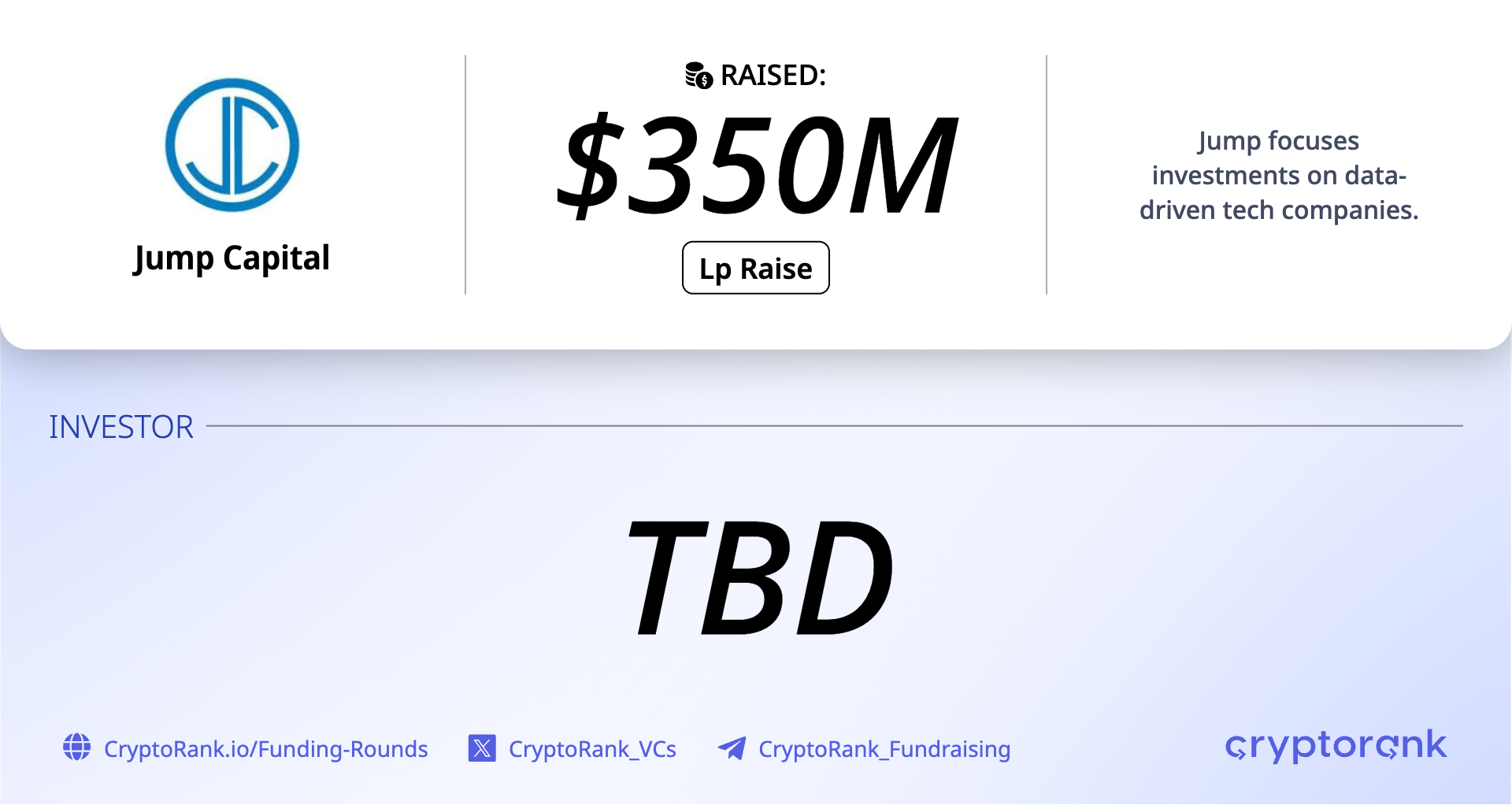
Jump Capital, the Chicago-founded venture firm launched alongside quantitative trading powerhouse Jump Trading, has closed its eighth institutional fund at $350 million, the largest vehicle in the firm's history. According to the firm's own framing and corroborating trade coverage, Fund 8 is focused on AI infrastructure, cybersecurity and developer tooling, backing founders building at the application, infrastructure and security layers of the enterprise AI stack. The close was announced July 29, 2026. It matters because it is a rare nine-figure early-stage fund closing at a moment when LPs have been concentrating commitments in a shrinking number of brand-name managers, and because Jump has historically differentiated itself by investing outside the coastal VC hubs.
Key Takeaways
A thematic bet on three linked AI shifts. Jump's own framing for Fund 8 centers on three connected changes: application-layer software being rebuilt around AI rather than incrementally upgraded, a new enterprise infrastructure layer emerging to support model-driven workloads, and cybersecurity models adapting to environments where autonomous agents take action without tight human oversight. That is a coherent, stack-spanning thesis rather than a scattershot "we do AI too" positioning.
Watch for conflicting characterizations in the trade press. A handful of crypto-focused outlets described this raise as a "crypto fund," a mischaracterization that appears to stem from Jump Capital's well-documented crypto investing history through its dedicated crypto team (led by partners Saurabh Sharma and Peter Johnson) and sister firm Jump Trading. The more specific, dated coverage, including a trade press piece explicitly labeled as the firm's eighth institutional fund, describes Fund 8 as centered on AI infrastructure, cybersecurity and developer tooling. We are flagging this discrepancy explicitly rather than picking a side without a primary-source confirmation from Jump Capital itself.
Scale matters for a firm that built its brand on being non-coastal. Jump Capital's original thesis, dating back to its founding, was to bring institutional-caliber early-stage capital to founders outside Silicon Valley and New York. A $350 million fund, its largest yet, gives the firm room to write larger checks and lead more rounds without abandoning that founding identity, at a moment when regional tech hubs are producing a larger share of durable enterprise software companies than they did a decade ago.
Nearly 30 exits is a credible foundation, but it is historical, not Fund 8 performance. Jump Capital's broader portfolio has produced exits including Personal Capital (to Empower), Flashpoint (to Audax) and TubiTV (to Fox), plus a 2026 NYSE debut for crypto custody firm BitGo. That track record is real, but it reflects the firm's cumulative history across multiple funds and thesis areas, not a signal about how Fund 8's AI-focused bets will perform.
Fund Overview
Fund Name: Jump Capital Fund 8 (the firm's eighth institutional venture fund)
Fund Size: $350 million, the largest fund in Jump Capital's history
Stage: Early-stage, consistent with the firm's historical focus on Series A/B, though Fund 8's specific stage breakdown was not detailed in available reporting
Check Size: Not publicly disclosed for Fund 8
Geography: United States, with a historical emphasis on founders outside the coastal venture hubs
Focus: AI infrastructure, enterprise AI applications, developer tooling and cybersecurity for increasingly autonomous, agent-driven systems
Key LPs: Not disclosed in available public reporting
Why This Fund Matters
Early-stage venture fundraising has bifurcated sharply over the past two years: a small number of brand-name firms are raising ever-larger funds while many mid-market managers struggle to hit even reduced targets. A $350 million close for a firm outside the traditional Sand Hill Road or SoHo axis is a data point that LP appetite for differentiated, thesis-driven managers has not fully collapsed, provided the firm can point to a real track record and a sharp enough thesis to justify the allocation.
The thesis itself, three linked shifts across application, infrastructure and security layers, reflects a maturing view of enterprise AI investing. Early AI-native venture theses in 2023-2024 were heavily weighted toward foundation models and thin application wrappers; Jump's framing suggests a bet that the more durable opportunities now sit in the infrastructure plumbing (orchestration, runtime primitives for model-driven workloads) and in security tooling built for a world where software agents act autonomously rather than waiting for human approval at every step.
The crypto-versus-AI confusion in some of the coverage is itself instructive. Jump Capital has run a dedicated, growing crypto investing team since spinning up that effort roughly seven years ago, and the firm's sister entity Jump Trading is a major crypto market participant. That overlapping identity creates real ambiguity for outside observers trying to characterize any new Jump Capital fund, and it is a reminder that trade press headlines, especially from outlets with a narrow beat, can bundle or mislabel a manager's actual focus. We would treat the AI-infrastructure framing as the better-supported read based on the more specific, dated coverage, while flagging that Jump Capital has not, as of this writing, published its own detailed blog post or press release confirming Fund 8's full thesis on its public site.
For LPs and founders alike, the signal to watch is deployment. If Jump's near-term checks land predominantly in AI infrastructure, security and developer tooling companies, that will resolve the ambiguity in the reporting. If a meaningful share instead flows into crypto-adjacent companies, the "crypto fund" characterization will look more accurate than Jump's own AI framing suggests.
The Team
Jump Capital was co-founded by Sach Chitnis and Mike McMahon, who remain Co-Founders and Partners at the firm today. The current partner bench, per the firm's own team page, also includes Jason Felger, Tarun Gupta, Saaya Nath Pal and Yelena Shkolnik, alongside Operating Partner Pete Carroll and a broader team of associates, principals and operating specialists. The firm's dedicated crypto investing effort is led by partners Saurabh Sharma and Peter Johnson, distinct from the generalist early-stage team that has historically driven Jump's Series A/B enterprise software and fintech investing. Readers should note that public bios for a growing firm can lag; we are relying on Jump Capital's current team page as the primary source for these titles rather than older press coverage or third-party aggregators.
What This Means for Founders
Founders building at the application, infrastructure or security layers of the enterprise AI stack, particularly outside the traditional coastal hubs, are the most natural fit for Fund 8. Jump's historical differentiation has been operational engagement (the firm markets a dedicated "operating platform" alongside capital) rather than passive check-writing, so founders should expect a hands-on investor if Jump leads a round.
Given the ambiguity in current public reporting around Fund 8's exact stage focus and check sizes, founders considering a pitch should engage directly with the firm to confirm current investment parameters rather than relying on secondary coverage, including this article, for those specifics.
Fund Momentum Take
We like the thesis on its face: it is more precise than a generic "we invest in AI" positioning, and it reflects a defensible view that infrastructure and security will matter as much as the application layer as enterprise AI adoption matures. A firm with nearly a decade and a half of institutional history and close to 30 exits behind it has earned the benefit of the doubt on execution.
Our caution is squarely about sourcing clarity. We were unable to locate a dedicated, dated blog post or press release on Jump Capital's own site specifically announcing Fund 8, its size and its thesis in the firm's own words, which is the gold standard for fact-checking a fund story. What we have instead is consistent characterization across multiple dated trade outlets (all pointing to AI infrastructure, cybersecurity and developer tooling) set against a smaller number of crypto-focused outlets using a "crypto fund" framing that appears to conflate Fund 8 with Jump's separate, longstanding crypto investing practice. We are publishing based on the weight of the more specific evidence, but we would treat any claims about specific check sizes, named LPs, or a formal stage mandate for Fund 8 as unconfirmed until Jump Capital publishes its own announcement.
Our bet: this fund performs well precisely because the ambiguity in the public narrative does not reflect ambiguity inside the firm. Jump has run a focused thesis process for eight funds now; the confusion here looks like a trade-press labeling problem, not a strategy problem.
Frequently Asked Questions
How big is Jump Capital's new fund?
Fund 8 closed at $350 million, described by the firm and multiple trade outlets as the largest fund in Jump Capital's history.
What does Jump Capital's Fund 8 invest in?
Based on the most specific and dated reporting available, Fund 8 targets AI infrastructure, enterprise AI applications, developer tooling and cybersecurity for autonomous, agent-driven systems.
Is Jump Capital's new fund focused on crypto?
Some outlets characterized it as a crypto fund, but the more specific dated coverage describes an AI infrastructure and security focus. Jump Capital does run a separate, dedicated crypto investing team, which appears to be the source of the confusion. We were not able to confirm the exact thesis from a primary Jump Capital announcement as of publication.
Who leads Jump Capital?
Co-Founders and Partners Sach Chitnis and Mike McMahon, alongside a partner group that includes Jason Felger, Tarun Gupta, Saaya Nath Pal and Yelena Shkolnik.
What has Jump Capital's track record been?
The firm reports over 100 investments and nearly 30 exits across its history, including Personal Capital (to Empower), TubiTV (to Fox) and a 2026 NYSE listing for crypto custody firm BitGo, though these reflect the firm's cumulative history rather than Fund 8 specifically.
Have a fund closing to announce? Submit your fund here.
Need help raising capital? Check out our Fundraising Advisory services.
Related funds in the index
Seed · AI/ML funds from the verified index
| Fund | Size | Stage | Location | Focus |
|---|---|---|---|---|
| Nomi Capital Defense Fund I | $50M USD | Seed | United States | Defense, Space +3 |
| Inflexor Ventures Fund III | $48M USD | Seed | India | Deep Tech, Semiconductors +3 |
| Khosla Ventures 2026 Fund Family | Up to $5.5B (targeted, reported) USD | Seed | United States | AI/ML, Deep Tech +3 |
| Dimension III | $800M USD | Seed | United States | Biotech, AI/ML +1 |
| Greylock 18 | $1.5B USD | Seed | United States | AI/ML, Cybersecurity +3 |