
Enable Ventures Closes $50.31M Debut Disability-Tech Fund
TL;DR
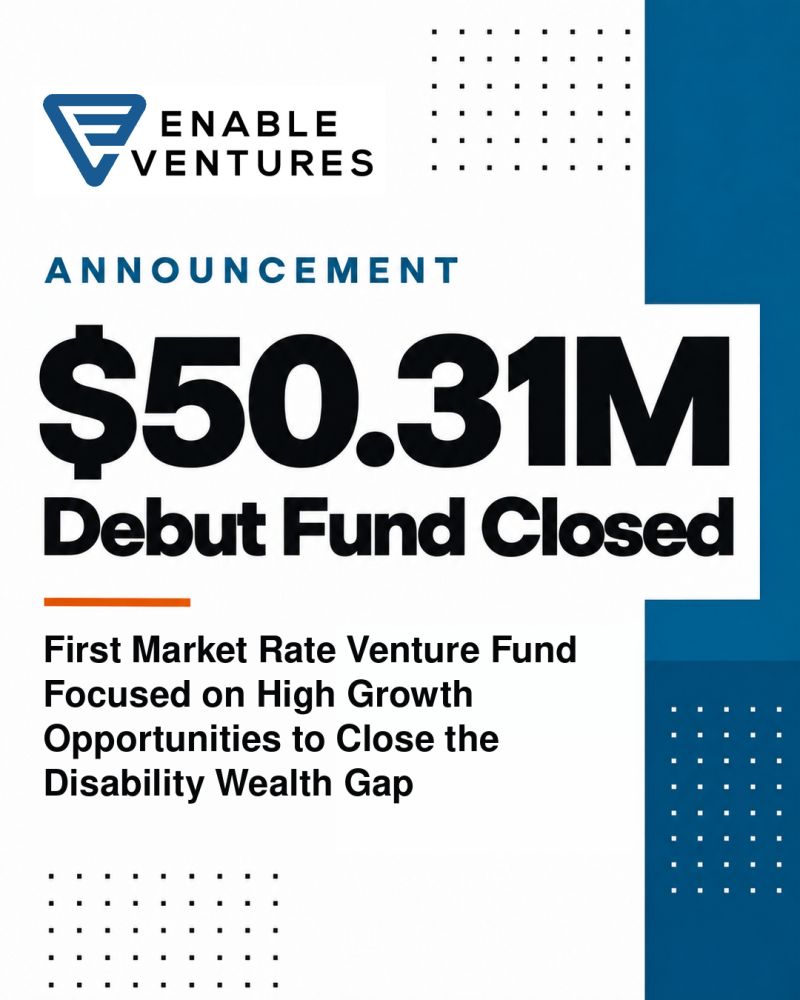
Enable Ventures, founded by civil rights attorney Regina "Gina" Kline, has closed its debut fund at $50.31 million, which the firm bills as the first market-rate venture fund built specifically to close the disability wealth gap through investments in AI-driven, disability-inclusive technology. Anchored by Sorenson Impact Group and backed by an unusually corporate and foundation-heavy LP base, including UnitedHealth Group, Liberty Mutual Investments, the Ford Foundation, and Ally Bank, the fund has already deployed into 11 companies spanning worktech, digital health, and assistive technology. It matters because Enable is testing a thesis the rest of venture has largely ignored: that designing AI products around the disability community from day one is a genuine performance and market-expansion advantage, not a CSR line item, and its LP roster suggests some of the largest healthcare, insurance, and financial institutions in the country are now willing to underwrite that bet with real capital rather than grant dollars.
Key Takeaways
The fund closed well below its earlier target, and the gap is worth naming. Enable was reportedly targeting around $75 million as of a late-2024 report on its raise; the final close came in at $50.31 million. That's a meaningful shortfall in a fundraising environment that's been brutal for first-time, thesis-driven impact funds generally, and it's a more honest signal about market appetite for this category than the closing headline number alone suggests.
The LP base is the real story, not the fund size. UnitedHealth Group, Liberty Mutual Investments, Ally Bank, Ascension, and The Doctors Company aren't typical fund-of-funds or family-office LPs, they're strategic corporates with direct commercial exposure to the disability and aging population as customers, claimants, and employees. When an insurer and a health system back a disability-tech venture fund, that's a bet the portfolio will also generate proprietary deal flow and product insight back into their own businesses, not just financial returns.
This is a "mature seed to Series A" fund wearing a debut-fund label. According to prior reporting, Enable's stage focus skews toward mature seed and Series A rather than pre-seed, which tracks with backing already-scaled names like Be My Eyes and Cionic in its 11-company portfolio. That's a more de-risked, later-entry strategy than the typical impact-labeled debut fund, and it should make LPs more comfortable with return timelines even at a smaller fund size.
Kline's operator background is unusually specific to the thesis. A former U.S. Department of Justice Civil Rights Division trial attorney who went on to found SmartJob LLC, Kline isn't a generalist VC who picked up a social thesis, she's spent her career inside disability rights and employment law before moving into venture. Combined with Principal Charlotte Magee's neuroscience PhD and prior work at Sorenson Impact Institute, the team's domain expertise is a genuine differentiator in sourcing and diligence, not just positioning.
Fund Overview
Fund Name: Enable Ventures (Fund I)
Fund Size: $50.31 million (final close; publicly reported as targeting roughly $75 million as of late 2024)
Stage: Early-stage, skewing mature seed to Series A
Check Size: Not publicly disclosed
Geography: Primarily U.S.-based portfolio with some international reach (e.g., Chile-based Wheel the World)
Focus: AI- and ML-driven, disability-inclusive technology across four allocation areas: upskilling and reskilling for work, inclusive workplace technologies, next-generation assistive technology, and founders with disabilities
Key LPs: Sorenson Impact Group (anchor), UnitedHealth Group, Liberty Mutual Investments, The Ford Foundation, Ally Bank, SHRM, Ascension, Social Finance, The Doctors Company, Guy's & St Thomas' Foundation, and the Weingart Foundation
Why This Fund Matters
Disability tech has been a persistent blind spot in venture despite the numbers: over a billion people globally live with a disability, and in the U.S. alone that population controls meaningful discretionary spending power that most consumer and enterprise product teams simply don't design for. What's changed in 2026 is the AI overlay. Enable's framing, that AI makes disability-inclusive design more valuable, not less, cuts against the more common industry worry that AI systems trained on non-representative data actively degrade accessibility. Enable is betting the opposite: that companies solving accessibility problems well are building the same underlying capabilities, adaptive interfaces, multimodal input handling, personalization at the edge, that make for genuinely differentiated AI products more broadly.
The LP list is the clearest evidence that this thesis has moved from advocacy to institutional finance. UnitedHealth Group and Ascension have direct P&L exposure to disability and chronic-condition populations through claims and care costs; Liberty Mutual underwrites disability and workers' comp risk; Ally Bank and SHRM both touch workplace accommodation and financial-access questions for disabled employees and customers. This isn't a typical impact-fund LP base of foundations writing catalytic checks, it's corporates with a commercial reason to want a front-row seat on emerging disability tech, which should give Enable's portfolio companies real customer and distribution access beyond the check itself.
The stage focus, mature seed through Series A rather than pre-seed, is a deliberate hedge against the two hardest problems in impact-labeled venture: return timelines that don't match traditional fund life, and a sourcing pipeline too thin to deploy a full fund at the earliest, riskiest stage. By entering after companies like Be My Eyes and Cionic have already proven initial product-market fit, Enable is optimizing for capital efficiency and faster path to follow-on validation, a sensible choice for a debut fund manager who needs an early, legible win to raise Fund II.
The gap between the reported ~$75 million target and the $50.31 million final close deserves honest scrutiny rather than a headline gloss. First-time impact and thesis-driven funds have had a genuinely difficult fundraising market over the past two years as LPs consolidated around fewer, larger managers; a roughly one-third shortfall from an earlier target is consistent with that broader environment rather than necessarily a thesis-specific problem, but it does mean Enable will need to prove capital efficiency, likely fewer, more concentrated bets, rather than the broader spray-and-pray a full $75 million might have allowed.
The Team
Regina "Gina" Kline is Founder and Managing Partner. She spent 15 years as a civil rights attorney, including as a Trial Attorney in the U.S. Department of Justice's Civil Rights Division, before founding SmartJob LLC and later launching Enable Ventures in 2022. She holds a J.D. from the University of Maryland School of Law and a B.A. from Columbia University.
Jim Sorenson is listed as a co-founder of the fund and is Founder and Executive Chairman of Sorenson Impact Group, which serves as the fund's anchor backer; his role is best understood as the fund's founding strategic partner and anchor LP rather than a day-to-day investment decision-maker. Charlotte Magee, PhD, is a Principal on the investment team; she holds a neuroscience PhD from the University of Utah and previously worked as a Principal at the Joan and Tim Fenton Founders Fund and as Manager of Venture Capital and Impact Investing at the Sorenson Impact Institute. Emma Stone is Vice President, focused on disability employment policy and business innovation, having previously served as a Summer Venture Fellow at Enable Ventures and a policy fellow in New York State government; she holds dual degrees in public policy from Harvard and business from MIT.
Early Portfolio
Enable Ventures' 11-company portfolio spans worktech, digital health, and assistive technology, including Be My Eyes (visual-assistance technology connecting blind and low-vision users with sighted volunteers and AI), Cionic (AI-powered wearable neurotech for mobility), Ava (real-time captioning and accessibility communication), Daivergent (employment and workforce solutions for autistic and neurodivergent talent), Inclusively (disability-inclusive hiring and workplace accommodation platform), Wheel the World (accessible travel booking), DeepWalk, Mindset Care, Goodpath, Kalogon, and Pear Suite.
What This Means for Founders
If you're building AI-driven products for accessibility, workplace inclusion, assistive technology, or disability employment, and you already have initial traction, mature seed to Series A signal, Enable is one of the only dedicated, market-rate checks in this category, and its LP base means a founder who lands here gets warm introductions into major healthcare, insurance, and financial-services buyers that would otherwise take years of enterprise sales cycles to reach organically. The firm's own team composition also means genuine subject-matter diligence rather than a generalist VC learning the space on your dime.
It's a weaker fit for pre-seed, pre-revenue founders or teams without a disability-inclusive design thesis baked into the product from the start; Enable's stage focus and strategic-LP structure suggest they're optimizing for companies that can convert quickly into case studies their corporate backers can point to internally. Founders earlier in that curve should look to disability-focused angel networks and accelerators first and treat Enable as a logical next check once initial traction is in hand.
Fund Momentum Take
We think the LP base here is more predictive of the fund's eventual success than the $50.31 million headline number. A debut manager convincing UnitedHealth Group, Ascension, Liberty Mutual, and Ally Bank to all write checks into the same thesis is a genuinely hard sourcing and credibility feat, and it suggests Enable's pipeline into follow-on capital and strategic partnerships for its portfolio companies will punch well above what the fund size alone implies.
The risk we'd flag plainly: falling short of a reported $75 million target on a debut fund makes the Fund II conversation harder, not easier, however good Fund I's early marks look. Enable will need at least one or two portfolio companies to generate clear, provable venture-scale outcomes, not just "good impact story" outcomes, within the next 24 months to make the case that market-rate returns and disability-inclusive design genuinely compound together rather than trading off against each other. That's the actual thesis being tested here, and it hasn't been proven at scale by anyone yet.
Our bet: the corporate-LP model Enable has assembled is the more durable innovation than the fund itself, expect other underserved-population-focused funds (aging, chronic illness, neurodivergence) to copy this playbook of recruiting strategic corporates with direct commercial exposure as anchor LPs rather than relying on foundations and impact-only capital, regardless of how Enable's own Fund I performance ultimately plays out.
Frequently Asked Questions
How big is Enable Ventures' debut fund?
Enable Ventures closed its first fund at $50.31 million, below a roughly $75 million target reported in late 2024.
What does Enable Ventures invest in?
The fund backs AI- and ML-driven, disability-inclusive technology companies across worktech, digital health, and assistive technology, generally at the mature seed to Series A stage.
Who leads Enable Ventures?
Regina "Gina" Kline, a former U.S. Department of Justice Civil Rights Division attorney, is Founder and Managing Partner. Charlotte Magee, PhD, is a Principal, and Emma Stone is Vice President. Jim Sorenson of Sorenson Impact Group is a co-founder and the fund's anchor backer.
Who are Enable Ventures' limited partners?
Sorenson Impact Group anchors the fund, alongside LPs including UnitedHealth Group, Liberty Mutual Investments, the Ford Foundation, Ally Bank, SHRM, Ascension, Social Finance, The Doctors Company, Guy's & St Thomas' Foundation, and the Weingart Foundation.
What companies has Enable Ventures invested in?
Its 11-company portfolio includes Be My Eyes, Cionic, Ava, Daivergent, Inclusively, Wheel the World, DeepWalk, Mindset Care, Goodpath, Kalogon, and Pear Suite.
Have a fund closing to announce? Submit your fund here.
Need help raising capital? Check out our Fundraising Advisory services.
Related funds in the index
AI/ML funds from the verified index
| Fund | Size | Stage | Location | Focus |
|---|---|---|---|---|
| AIP Seed | $40M USD | Pre Seed | Poland | AI/ML, FinTech +3 |
| Nomi Capital Defense Fund I | $50M USD | Seed | United States | Defense, Space +3 |
| Worldbuild Fund I | $30M USD | Pre Seed | United States | Data Infrastructure, AI/ML +3 |
| Inflexor Ventures Fund III | $48M USD | Seed | India | Deep Tech, Semiconductors +3 |
| Haystack Fund VIII | $85M USD | Pre Seed | United States | Consumer & Commerce, Cloud & DevOps +3 |