
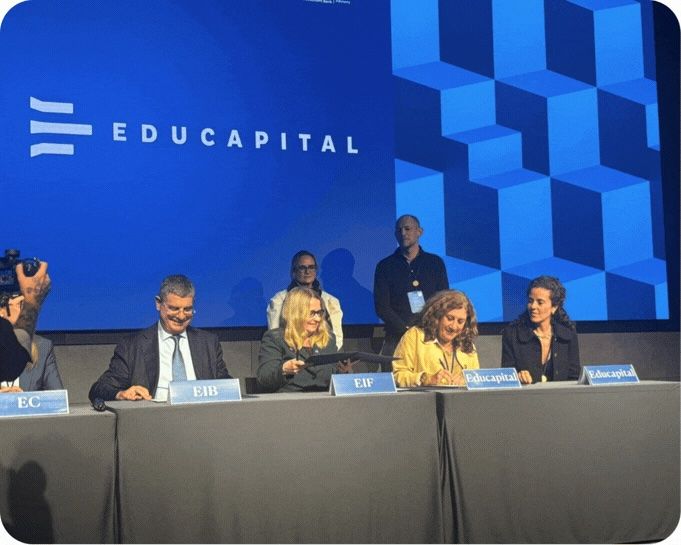
EIF Commits €20M to Educapital III Edtech Fund
TL;DR
Educapital, the Paris-based pan-European venture firm dedicated to Edtech and the Future of Work, has secured a €20 million commitment from the European Investment Fund (EIF) toward Educapital III, its third fund, which is currently being raised. The commitment extends a relationship that began with Educapital II, a roughly €150 million vehicle the EIF backed through the EU's InvestEU programme and which held its final close in April 2023. Educapital hasn't disclosed a target size for Fund III, but the signal is clear: an anchor LP that already knows the firm's track record intimately is doubling down before the round is even closed. It matters because Educapital is one of the only dedicated, B Corp-certified Article 9 impact funds investing Seed-to-Series-B across the entire education-to-work pipeline in Europe, and its first unicorn, language-learning platform Preply, just validated the thesis with a $150 million raise at a $1.2 billion valuation in January 2026.
Key Takeaways
A repeat LP commitment before final close is a stronger signal than a fresh logo. Any fund can round up new institutional names for a press release. An LP that backed the prior fund, watched it perform through a full cycle, and is committing again before the current fund has even locked in its size is telling you something a first-time commitment can't: the underlying unit economics of the strategy held up under scrutiny from an investor with full visibility into the portfolio.
Educapital's first unicorn landed at almost exactly the right moment. Preply's $150 million raise at a $1.2 billion valuation in January 2026 gives Educapital a marquee outcome to point to just as it's back in market for Fund III. That's not a coincidence any fundraising GP would mind; a unicorn mark eight months before you're asking LPs to recommit is about as clean a proof point as the venture model produces.
The thesis is aging well precisely because AI is disrupting it from both directions. Educapital's pitch is that education and skills infrastructure need reinvention because skills are becoming obsolete faster than institutions can retrain people for them. AI is simultaneously the tool making personalized learning at scale possible and the primary reason skills are decaying faster. A fund built around that tension has a thesis that gets more relevant, not less, every quarter that AI adoption accelerates.
Sovereignty framing is doing real work in this LP pitch. Both co-founders explicitly invoke "European sovereignty" in their quotes, tying edtech and skills investment to the same competitiveness anxieties driving European capital toward defence and deeptech. That's a savvy repositioning for an LP base (the EIF chief among them) that increasingly frames every commitment through a European-strategic-autonomy lens, whether the sector is chips, defence, or now, human capital.
Fund Overview
Fund Name: Educapital III
Fund Size: Currently being raised; total target not yet disclosed. The EIF has committed €20 million. Predecessor Educapital II raised approximately €150 million (final close, April 2023); Educapital I raised €47 million (launched 2017). Combined AUM across Funds I and II is approximately €200 million.
Stage: Seed to Series B
Check Size: Up to €10 million per investment
Geography: Pan-European, with disclosed portfolio companies based in France, Germany, Italy and Lithuania
Focus: Edtech and the Future of Work, spanning school, higher education, lifelong learning, skills development and workplace transformation
Key LPs: European Investment Fund (via InvestEU, as it did for Fund II)
Why This Fund Matters
Edtech as a category has had a rough few years by public-market and late-stage-VC standards, with valuations resetting hard after the 2021 pandemic-era boom and plenty of generalist funds quietly retreating from the sector. Educapital's continued ability to raise, and to attract a repeat commitment from a sophisticated development-finance LP, suggests the category's early-stage economics look considerably healthier than the sector's late-stage headlines would imply, at least for a specialist fund with a decade of pattern recognition rather than a generalist fund that added "edtech" to its thesis during the 2021 cycle.
The Future of Work half of the mandate is arguably the more interesting bet right now. Pure-play edtech, consumer or B2C learning products, has been a genuinely difficult venture category for years; the companies that have broken out tend to sit closer to workforce infrastructure, corporate learning and management platforms (360Learning, in Educapital's own portfolio, is a good example), or vertical upskilling tied directly to an employer's hiring or retention problem. A fund that spans the full journey from "school" to "the transition into the Future of Work" gets exposure to both the harder-to-monetize consumer learning layer and the considerably more venture-friendly enterprise skills and workforce layer, which is a sensible hedge within a single thesis.
The Article 9 impact-fund structure is also worth taking seriously rather than treating as marketing. Under SFDR, Article 9 is the strictest EU sustainable-finance classification, requiring a fund to have sustainable investment as its explicit objective, not merely as a consideration. Educapital has built a proprietary impact measurement framework to back that classification with actual tracked metrics rather than a checkbox. For an LP base that increasingly includes development finance institutions and pension funds under their own ESG mandates, that structural choice widens the pool of capital that can commit to Educapital III relative to a fund without that classification.
The honest counterpoint: without a disclosed target size, it's hard to assess whether Educapital III represents meaningful step-up ambition or a more cautious, in-line-with-Fund-II raise in a fundraising environment where LPs have grown more selective about first and second-time-scale European VC funds. A press release built entirely around an LP re-up, rather than a first or final close with a headline number, is itself a data point: it suggests the firm wanted a signal in market now, ahead of whatever the eventual close figure turns out to be.
The Team
Educapital was founded in 2017 by Marie-Christine Levet and Litzie Maarek, who remain Founding Partners. The investment team includes Jonathan Denais and Alexandre Glaser as Investment Directors, alongside Alexis Pavy as Associate and Géraldine Fillet as Senior Associate. Maxime Lacoume serves as General Secretary and CFO, with Elie Vacqué as Junior Financial Controller. The firm has kept a compact, specialist team structure across three fund vintages rather than scaling headcount aggressively, consistent with a strategy built around deep sector focus rather than broad generalist coverage.
Early Portfolio
Across Educapital I and II, the firm has backed more than 45 companies, including Preply (its first unicorn, reaching a $1.2 billion valuation on a $150 million raise in January 2026), 360Learning, Knowunity, MyEdSpace, Edflex, LiveMentor, Simundia, Lunii, Vocal Image, FourthRev, LibraCyber, Tomorrow University and Hupso, spanning consumer learning, corporate L&D and workforce-transition platforms across multiple European markets.
What This Means for Founders
For founders building at the intersection of education, skills and the future of work, Educapital's willingness to write checks from Seed through Series B (up to €10 million per deal) means the firm can lead an early round and continue supporting a company through its growth inflection without forcing a change of lead investor. The pan-European remit, with existing bets in France, Germany, Italy and Lithuania, also signals the firm is genuinely looking beyond the Paris-London-Berlin axis that dominates most generalist European VC coverage.
Founders should also weigh the impact-fund structure honestly: Educapital's Article 9 classification means portfolio companies will be expected to track and report against real impact metrics, not just growth metrics. That's a genuine value-add for founders whose businesses are impact-native by design (which most edtech and workforce companies are), but it's a diligence and reporting layer worth understanding upfront rather than discovering after the term sheet is signed.
Fund Momentum Take
An LP re-up announcement ahead of a fund's close is a smaller story than a headline final close, but it's arguably a more honest signal of conviction: the EIF had full visibility into how Educapital II actually performed before deciding to commit again, and they said yes. Preply crossing unicorn status eight months before this announcement doesn't hurt the narrative, but the more durable point is that a decade-old specialist thesis in a sector plenty of generalists have abandoned is still attracting repeat institutional capital.
Our read: edtech has been unfashionable enough for long enough that the category is arguably underpriced relative to the structural tailwind it's riding, which is that AI is forcing every company and government in Europe to rethink workforce skilling on a compressed timeline. The risk is that Educapital hasn't yet told the market what Fund III's actual size or step-up ambition looks like, and until that number lands, it's difficult to judge whether this is a fund quietly building toward a larger vehicle or one calibrating a more conservative raise for a harder fundraising market. We'll be watching for the eventual close figure as the real test of how much LP appetite this thesis can pull in at scale.
Frequently Asked Questions
What is Educapital III?
It's the third fund from Educapital, a pan-European venture capital firm specialising in Edtech and the Future of Work, founded in 2017. The fund is currently being raised; no total target size has been disclosed.
How much has the European Investment Fund committed?
€20 million, extending a relationship that began with Educapital II, which the EIF also backed through the EU's InvestEU programme.
What stage and check size does Educapital invest at?
Seed to Series B, with checks of up to €10 million per company.
How big were Educapital's previous funds?
Educapital I raised €47 million at launch in 2017; Educapital II raised approximately €150 million and held its final close in April 2023. Combined AUM across both funds is roughly €200 million.
What is Educapital's most notable portfolio outcome?
Language-learning platform Preply became the firm's first unicorn in January 2026, raising $150 million at a $1.2 billion valuation. The portfolio also includes 360Learning, Knowunity, LiveMentor and Lunii, among more than 45 companies.
Have a fund closing to announce? Submit your fund here.
Need help raising capital? Check out our Fundraising Advisory services.
Related funds in the index
Digital Education (Consumer) funds from the verified index
| Fund | Size | Stage | Location | Focus |
|---|---|---|---|---|
| Kalos Ventures Fund I | $78.8M USD | Seed | United States | Digital Education (Consumer), Digital Health +2 |
| Hlayisani Venture Fund II | R500M ZAR | Series A | South Africa | FinTech, Digital Health +3 |
| Clover Fund I | €30M EUR | Pre Seed | France | AI/ML, Digital Education (Consumer) +1 |
| Investing For Purpose Fund (IFP) | €25M EUR | Pre Seed | Greece | Climate & Sustainability, Digital Education (Consumer) |
| Constructor Capital | €93M EUR | Seed | Switzerland | Deep Tech, AI/ML +2 |