
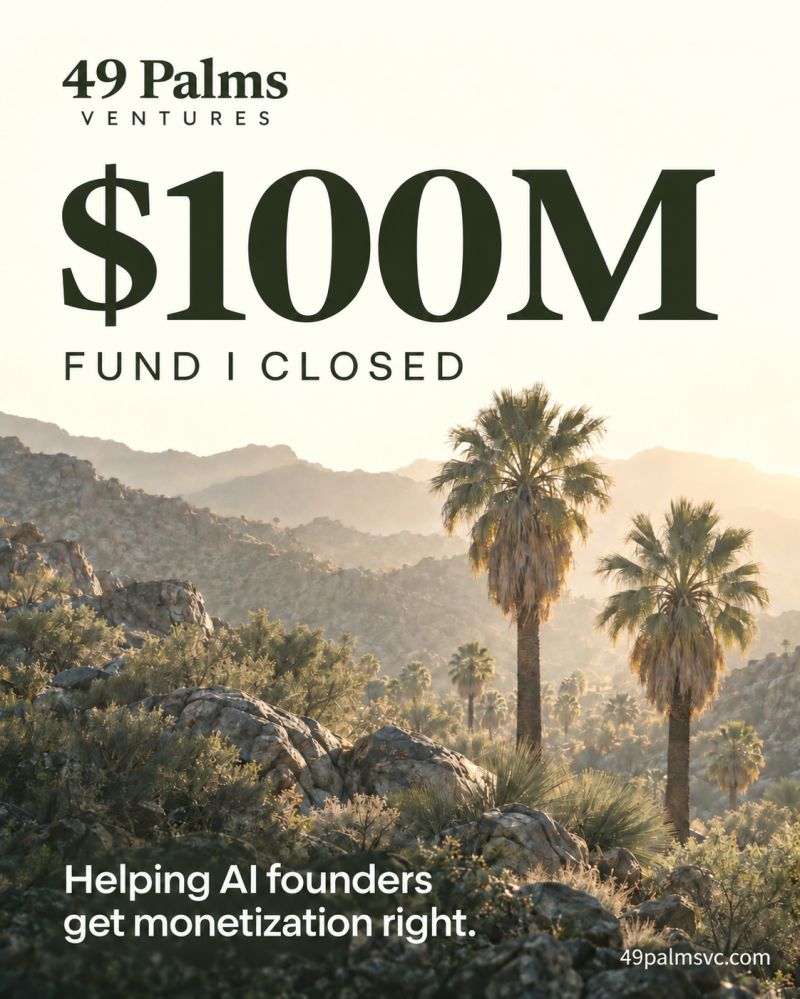
49 Palms Ventures Launches $100M Fund I for AI Pricing
TL;DR
49 Palms Ventures has come out of stealth with a $100 million debut fund, closed and already deployed into 14 companies, including Skild AI, Ollama, Delphi, and Exa. The firm was co-founded by Madhavan Ramanujam and Josh Bloom, two former Simon-Kucher & Partners senior partners who spent their careers advising Fortune 500 and startup clients on monetization and pricing. Rather than compete head-on for lead positions, 49 Palms co-invests alongside established VCs and sells a specific, repeatable value-add: helping AI founders figure out what to charge for, how to structure early proof-of-concepts into paid contracts, and how to negotiate first enterprise deals. It's a pricing-consultancy-to-venture-fund model that's rare in VC and unusually well-matched to where AI startups are actually struggling right now.
Key Takeaways
This is a services-to-capital fund, built around a genuinely scarce skill. Most VCs who claim to "help with go-to-market" are generalists offering intros and advice. Ramanujam and Bloom spent over a decade each inside Simon-Kucher, a firm whose entire business is pricing and monetization strategy, reportedly working across more than 500 companies and 100+ unicorns between them. That's a narrower and more defensible expertise claim than the typical VC value-add pitch, and it happens to map almost perfectly onto the question every AI founder is currently struggling with: how do you price a product whose cost structure and usage patterns don't look like traditional SaaS.
Co-investing instead of leading is a deliberate, capital-efficient structure for a specialist debut fund. By riding alongside lead investors rather than sourcing and pricing rounds independently, 49 Palms doesn't need the deal-sourcing infrastructure or brand recognition a $100 million lead-check fund would require to compete for allocation. It gets access to competitive rounds through the quality of its monetization advice, which is a different and arguably lower-risk way to build a first fund's track record.
The portfolio is already a who's-who of well-capitalized AI infrastructure and model companies. Skild AI (humanoid robotics foundation models) and Ollama (local LLM tooling) are among the more closely watched names in AI infrastructure; landing both in a debut fund's first 14 investments suggests Ramanujam and Bloom's monetization pedigree opened doors to rounds that were almost certainly oversubscribed. That's a stronger early signal than fund size alone.
The pricing question in AI is genuinely unresolved, and that's the opportunity this fund is pricing in. Usage-based, outcome-based, seat-based, and hybrid pricing models are all being tested simultaneously across the AI startup landscape, with no consensus winner. A fund whose GPs have spent their careers on exactly this problem is betting that founders will pay (in equity, via a venture check) for help getting pricing right the first time, rather than learning it through a year of trial and error with enterprise customers.
Fund Overview
Fund Name: 49 Palms Ventures Fund I
Fund Size: $100 million, per the firm's own announcement; independent trade press confirmation was not available as of this writing
Stage: Not formally disclosed; portfolio spans early-stage and more established, well-funded AI companies
Check Size: Not disclosed
Geography: Not disclosed; portfolio companies are predominantly US-based
Focus: AI founders, with a co-investment model built around monetization and pricing advisory (POC-to-contract conversion, enterprise deal structuring, usage/outcome/hybrid pricing design)
Key LPs: Not disclosed
Why This Fund Matters
Pricing has become one of the most consequential and least-solved problems in AI go-to-market. Unlike traditional SaaS, where per-seat pricing was a known playbook by the time most founders started a company, AI products carry variable compute costs, unpredictable usage patterns, and customers who are often unsure whether they're buying a tool, an outcome, or a replacement for headcount. Founders are making pricing decisions with real margin and retention consequences long before they have the data to make them well, and most venture firms have no particular expertise to offer on the question beyond general intuition.
49 Palms is explicitly underwriting that gap. Simon-Kucher's core business for decades has been exactly this: helping companies, many far larger and more established than a seed-stage AI startup, figure out what to charge and how to structure the offer. Ramanujam's own writing (Monetizing Innovation, Scaling Innovation) argues that pricing and packaging decisions made early in a product's life are disproportionately hard to unwind later, which is precisely the argument for getting specialist help at the POC-to-contract stage rather than after a company has already trained its sales team on the wrong model.
The co-investment structure also says something about how the firm is positioning itself competitively. Rather than trying to out-source-deal firms like a16z or Founders Fund, which both appear to be co-investors alongside 49 Palms given the overlap in portfolio companies with major AI rounds, 49 Palms is positioning itself as a value-add layer that lead investors and founders both want in the round, not a replacement for them. That's a lower-ego, lower-risk path to building a first fund's reputation, and it lets the firm concentrate its actual expertise, pricing and monetization, rather than spreading itself thin trying to compete on sourcing or brand.
The open question is durability. Simon-Kucher's advisory relationships and the personal networks Ramanujam and Bloom built over a decade-plus are almost certainly what got 49 Palms into rooms with Skild AI and Ollama's caliber of company. That's a real, earned advantage for a debut fund, but it's also a founder-dependent asset: whether it scales past Fund I, and whether the firm can keep winning allocation in competitive rounds once being "the Simon-Kucher guys" is less novel, is the thing to watch over the next two to three years.
The Team
Madhavan Ramanujam is co-founder and General Partner at 49 Palms Ventures. He spent his career at Simon-Kucher & Partners, most recently as Senior Partner and Managing Partner of APAC, where he led more than 125 monetization projects for internet, software, and technology clients and co-authored Monetizing Innovation and Scaling Innovation. He holds degrees from the Indian Institute of Technology, Chennai, and Stanford Graduate School of Business.
Josh Bloom is co-founder and General Partner. He was previously a Senior Partner at Simon-Kucher based in San Francisco, where he spent more than a decade helping technology companies grow revenue through pricing, marketing, and sales improvements, working with over 100 companies to create more than $1 billion in enterprise value by the firm's own account. He holds a BA in Economics from Yale University and an MBA from the University of Chicago Booth School of Business.
Rhian Davies and Mandar Kulkarni have joined as Principals, per the firm's launch announcement; their specific backgrounds were not detailed in the firm's public materials as of this writing.
Early Portfolio
49 Palms has already invested in 14 companies: Skild AI and Ollama (AI infrastructure and foundation models), Delphi, Paid, Exa, and Engram (AI infrastructure), Ricursive Intelligence and Elorian (foundational models), Edra and Rox (horizontal AI applications), and Skydive, Arbor, Symbio, and Nestera. The firm's own site groups several of these under AI infrastructure, foundational models, and horizontal AI, suggesting at least a loose thesis structure even without a formally disclosed stage or sector mandate.
What This Means for Founders
If you're an early-stage AI founder wrestling with how to structure a pilot into a paying contract, what to charge for versus give away, or how to design a usage- or outcome-based pricing model, 49 Palms is now a specific, credentialed firm to approach, not just another generalist check. The firm has said explicitly that its DMs are open for exactly these questions, even outside a funding conversation, which is a lower-commitment way to test the fit before deciding whether to bring them into a round.
Founders should also understand what this fund isn't: it's a co-investor, not typically a lead, so the practical path to working with 49 Palms is usually through a round that already has a lead VC attached, or by reaching out early enough that they can help shape the deal structure before terms are set. Founders further along who've already locked in a pricing model that isn't working may get more value from the firm's advisory relationships than from fresh capital.
Fund Momentum Take
We like the thesis here more than most debut-fund stories we cover, because it isn't a repackaged generalist pitch. Pricing and monetization genuinely is an underserved, high-stakes problem in AI right now, and Ramanujam and Bloom have about as credible a claim to solving it as anyone currently raising a venture fund. The portfolio, Skild AI and Ollama especially, suggests the thesis is already opening real doors, not just a LinkedIn narrative.
Our caveat is the same one we'd raise for any first fund built on two people's personal brand and network: there's no independent trade press confirming the $100 million figure or the firm's LP base as of this writing, everything here traces back to the founders' own announcement and website. That's not unusual for a stealth-to-launch story, but it means the fund size, the "half of the $100 million is deployed across 14 companies" framing, and the degree of actual influence 49 Palms had in those rounds versus simply getting allocation, are all founder-reported rather than independently verified. We'd also note that monetization advisory is a service, and services businesses built into fund structures sometimes struggle to scale their differentiation past the two or three people who built the original reputation.
Our bet: this fund's Fund II will be meaningfully larger if even two or three of these 14 companies have a visible monetization win they can point to publicly, since "we helped them get pricing right" is a far easier story to sell to LPs than a generic markup. The bigger story to watch is whether other pricing and GTM consultancies follow Simon-Kucher alumni into venture, the way operator-led funds followed earlier waves of growth and ops specialists.
Frequently Asked Questions
How big is 49 Palms Ventures' first fund?
$100 million, according to the firm's own launch announcement. Independent confirmation of the figure was not available as of this writing.
Who founded 49 Palms Ventures?
Madhavan Ramanujam and Josh Bloom, both former Senior Partners at Simon-Kucher & Partners, a pricing and monetization consultancy.
What does 49 Palms Ventures actually do for founders?
It co-invests alongside lead VCs and advises portfolio companies specifically on monetization: structuring proof-of-concepts into paid contracts, negotiating enterprise deals, and designing pricing models (usage-based, outcome-based, or hybrid).
What companies has the fund backed?
14 companies as of launch, including Skild AI, Ollama, Delphi, Paid, Exa, Engram, Ricursive Intelligence, Elorian, Edra, Rox, Skydive, Arbor, Symbio, and Nestera.
Does 49 Palms Ventures lead funding rounds?
The firm describes its model as co-investing alongside leading venture firms rather than leading rounds itself.
Have a fund closing to announce? Submit your fund here.
Need help raising capital? Check out our Fundraising Advisory services.
Related funds in the index
AI/ML funds from the verified index
| Fund | Size | Stage | Location | Focus |
|---|---|---|---|---|
| 49 Palms Ventures Fund I | $100M USD | Seed | Global | AI/ML |
| Oraseya Capital Fund | AED 1B AED | Pre Seed | United Arab Emirates | Digital Health, FinTech +2 |
| Monte Carlo Capital Fund II | $15M USD | Pre Seed | Global | Deep Tech, AI/ML +2 |
| Spectrum Equity Fund XI | $2.5B USD | Growth | United Kingdom | Data Infrastructure, AI/ML +1 |
| Square Peg Fund 6 | $696M USD | Seed | Australia | AI/ML, FinTech +1 |