
Senovo Closes Fund IV Above $100M to Back European B2B Software Category Leaders
TL;DR
Munich- and Berlin-based Senovo has closed its fourth fund at more than $100M, extending one of Europe's longest-running specialist B2B software franchises. Across 12 years and four funds the firm has made 40-plus initial investments, produced 13 exits, and now counts three unicorns in its portfolio, including Parloa, the German agentic-AI company that became the country's first AI unicorn of 2025. Fund IV does not change the playbook: a handful of high-conviction Seed and Series A checks per year, €1-5M at entry, into teams building category-defining enterprise software. In a market drifting toward generalist mega-funds, Senovo is doubling down on focus.
Key Takeaways
Specialization, not size, is the whole pitch. Senovo has never tried to be a multi-stage platform. Fund IV is explicitly built around a few deep-conviction commitments per partner per year, in a single category, B2B software, where the team's operating playbooks on go-to-market, US expansion and scaling are the differentiator. In a 2026 venture market crowded with sprawling generalist vehicles, a disciplined sub-€150M specialist fund is a real strategic choice, not a fallback.
The track record now includes genuinely hard exits. This is not a paper portfolio. Senovo's data-lineage holding Manta was acquired by IBM in 2023 to bolster watsonx, and supply-chain-risk leader Riskmethods was bought by Blackstone-backed Sphera in 2022, with Senovo rolling equity into the combined company. Those are the kinds of strategic, trade-buyer outcomes that European B2B funds are often accused of lacking.
Parloa proves the thesis can produce outliers. Senovo backed Parloa early; in May 2025 it raised a $120M Series C at a $1B valuation and was crowned Germany's first AI unicorn of the year. For a fund that writes €1-5M seed and Series A checks, having an agentic-AI breakout in the book is the validation that the specialist model can still catch generational companies.
The portfolio is quietly AI-first and infrastructure-heavy. Recent additions, FINDIQ, FlowFuse, InfrOS, Lative, mama health, span machine-service automation, IoT and cybersecurity tooling, cloud infrastructure, sales planning and healthcare AI. The center of gravity has shifted from generic SaaS toward AI-native, deep-tech-adjacent enterprise products, which is where Fund IV's capital is clearly heading.
Fund Overview
Fund Name: Senovo Fund IV
Fund Size: Closed at more than $100M
Stage: Seed and Series A (post product-market fit, first revenues)
Check Size: €1-5M initial investment
Geography: European B2B software companies building for global markets, with strong US go-to-market support
Focus: AI-first B2B software, cybersecurity, industrial tech, open source, infrastructure and deep-tech-adjacent SaaS for mid-market and enterprise digitalization
Key LPs: Not disclosed
Why This Fund Matters
Senovo occupies an unusual niche in European venture: a category specialist that has stuck to one thesis, global B2B software built from Europe, since 2013, while most of its peers broadened into multi-stage, multi-sector platforms. Fund IV is a statement that the specialist model still works, and arguably works better in the current environment. When capital is concentrating at the top and generalists are competing on speed and check size, a fund that wins on domain depth and founder support is differentiating on something that cannot be bought with a bigger balance sheet.
The size is deliberately modest, and that is the point. At north of $100M deployed through a handful of commitments per partner each year, Senovo is structurally forced into concentration and ownership rather than index-style spray-and-pray. For Seed and Series A enterprise software, where the difference between a category leader and an also-ran often comes down to sales motion and international execution rather than raw capital, a focused fund with operating playbooks is well matched to the actual problem founders face.
It also matters because the firm has compounded credibility the hard way. Thirteen exits across four funds, including a clean strategic sale to IBM and a private-equity-backed consolidation exit via Sphera, is a meaningful liquidity record for a European specialist of this vintage. Combined with three unicorns in the book, Senovo can now point to both DPI-relevant exits and the kind of fund-returner upside that LPs underwrite a fourth fund to access.
The honest risk is concentration in every dimension: one category, a small number of bets, and a portfolio increasingly leaning into AI-native software at a moment when that label commands premium entry prices. If the AI-application layer compresses, a focused B2B-AI fund has fewer places to hide than a diversified generalist. Senovo's bet is that deep domain selection is exactly what protects it in that scenario, by being early and right rather than broad.
The Team
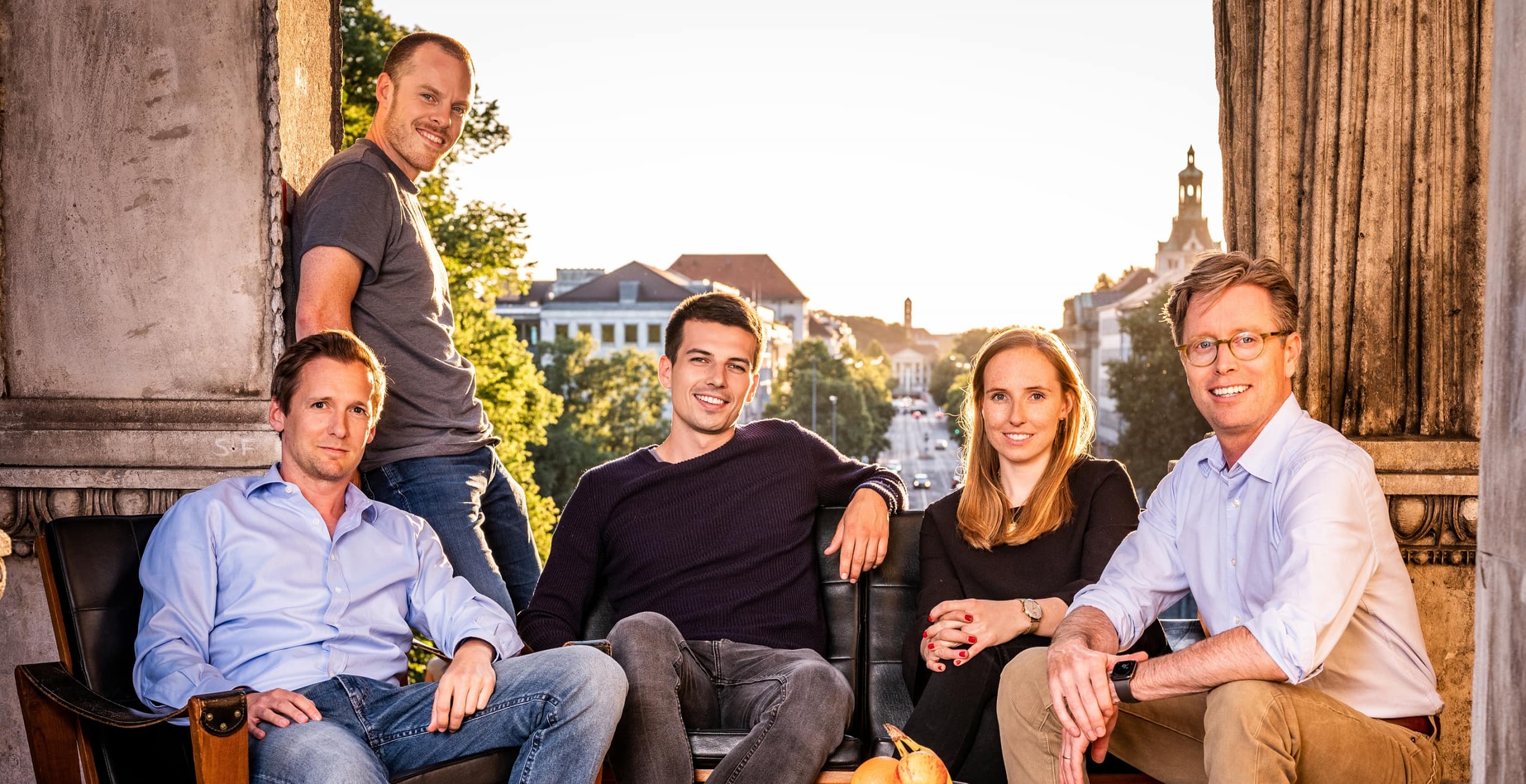
Senovo is run by a partner group of B2B software specialists operating from Munich and Berlin. Co-founders Frederick Mallinckrodt and Dr. Alexander Buchberger have led the firm since its early days, with Mallinckrodt bringing a Siemens and PE/M&A-law background and Buchberger a technology-management and startup-risk PhD; both have roughly a decade-plus of early-stage SaaS investing behind them. Markus Grundmann, a 20-year software-industry veteran with a Cambridge MBA and a deep-tech and enterprise bent, joined as partner in 2016 and authored several of the firm's marquee deals, including Manta and Quantilope. Mona Gindler rounds out the partnership with a focus on the founder-led-to-scalable-sales transition and the Iberian ecosystem, and serves as Germany's Female Founders Ambassador.
Worth being precise on roles: the investing partners are Mallinckrodt, Buchberger, Grundmann and Gindler. Lucas Behem is the firm's CFO rather than an investing partner, and Alberto Giovannetti is an analyst. That partner-led, four-decision-maker structure is consistent with the firm's stated model of one to two deals per partner per year, deep involvement over volume.
Early Portfolio
Senovo's active book spans customer-service and CX AI (Parloa), IoT messaging infrastructure (HiveMQ), supply-chain visibility (Project44), travel-tech (Holidu), strategic sourcing (Archlet), human-layer cybersecurity (CultureAI), and a growing set of AI-native newcomers such as FINDIQ, FlowFuse, Lative, Monda, Synthavo and mama health. The firm counts three unicorns among its holdings, the most recent and most visible being Parloa. On the realized side, the standout exits are Manta (acquired by IBM in 2023) and Riskmethods (acquired by Sphera in 2022), alongside earlier outcomes including Falcon.io's sale to Cision.
What This Means for Founders
If you are a European founder building B2B software with early revenue and genuine product-market fit, especially in AI-native enterprise tooling, cybersecurity, industrial tech, infrastructure or open source, Senovo is one of the more credible specialist leads on the continent for a Seed or Series A. The value proposition is concrete and operational: help building a scalable sales model, standing up performance-driven HR, and expanding internationally, particularly into the US, which is exactly the inflection where most European B2B companies stall before a larger growth round.
Calibrate to the model, though. This is a high-conviction, low-volume investor that wants meaningful ownership and a real seat at the table, not a long tail of small bets. Expect deep diligence, a partner who will be hands-on, and a bar set at category-leadership potential rather than incremental SaaS. Founders who want a passive check writing a quick term sheet should look elsewhere; founders who want a specialist partner for the hard scaling years should put Senovo at the top of the list.
Fund Momentum Take
We are bullish on this one, and our bias is on the record: in a cycle where so much European capital is chasing scale and optionality, a fund that has stayed narrow for over a decade and has the exits to show for it is exactly the kind of discipline that compounds. Senovo's edge is not capital, it is judgment and operating support inside a single category, and Fund IV is a clean continuation of a strategy that has already produced an IBM exit, a Sphera consolidation, and a German AI unicorn. That is a stronger hand than most fourth-time European specialists hold.
The risks are the mirror image of the strengths. Concentration cuts both ways, a small number of bets in one category means the fund lives and dies by selection, and the tilt toward AI-native software means entry valuations are unforgiving right now. A sub-$150M fund also has limited reserves to defend ownership through the mega-rounds that today's breakout AI companies raise, so Senovo will need its winners to either stay capital-efficient or to syndicate later rounds without being washed out. Parloa's trajectory will be an early test of how the firm manages dilution on a true outlier.
Our bet: Senovo Fund IV is one of the more underrated raises in European B2B venture this cycle, precisely because it is unglamorous. If the next four years deliver even one more Parloa-scale outcome on top of the existing exit record, this fund will quietly outperform a lot of louder, larger vehicles raised in the same window. The thing to watch is reserve discipline and whether the AI-first portfolio can convert premium entry prices into durable category leaders rather than expensive momentum bets.
Frequently Asked Questions
How large is Senovo Fund IV?
Senovo has closed Fund IV at more than $100M, to be invested in European B2B software companies at the Seed and Series A stage.
What does Senovo invest in?
Senovo backs global B2B software category leaders built from Europe, with a focus on AI-first products across cybersecurity, industrial tech, open source, infrastructure and enterprise SaaS, typically after product-market fit and first revenues. Initial checks run €1-5M.
Who runs Senovo?
The investing partners are co-founders Frederick Mallinckrodt and Dr. Alexander Buchberger, plus Markus Grundmann and Mona Gindler. Lucas Behem is CFO and Alberto Giovannetti is an analyst. The firm operates from Munich and Berlin.
What is Senovo's track record?
Over 12 years and four funds, Senovo has made 40-plus initial investments, recorded 13 exits, and built a portfolio that includes three unicorns. Notable exits include Manta (to IBM, 2023) and Riskmethods (to Sphera, 2022).
Which Senovo company is a unicorn?
Parloa, a Berlin-based agentic-AI customer-service company Senovo backed early, raised a $120M Series C at a $1B valuation in May 2025, becoming Germany's first AI unicorn of the year. It is one of three unicorns in Senovo's portfolio.
Have a fund closing to announce? Submit your fund here.
Need help raising capital? Check out our Fundraising Advisory services.
Related funds in the index
Series A · SaaS funds from the verified index
| Fund | Size | Stage | Location | Focus |
|---|---|---|---|---|
| Icehouse Ventures Growth Fund III | $150M USD | Series A | New Zealand | AI/ML, Deep Tech +2 |
| OSS Ventures Fund | €40M EUR | Series A | France | Manufacturing, SaaS +2 |
| Touring Capital I | $330M USD | Series A | United States | AI/ML, SaaS +1 |
| Chiratae Ventures V | $150M USD | Series A | India | AI/ML, Deep Tech +3 |
| Mars Sustainability Investment Fund | $250M USD | Series A | United States | AI/ML, Climate & Sustainability +1 |