Redbud VC Closes $25M Fund II to Back America's Outsider Founders
TL;DR
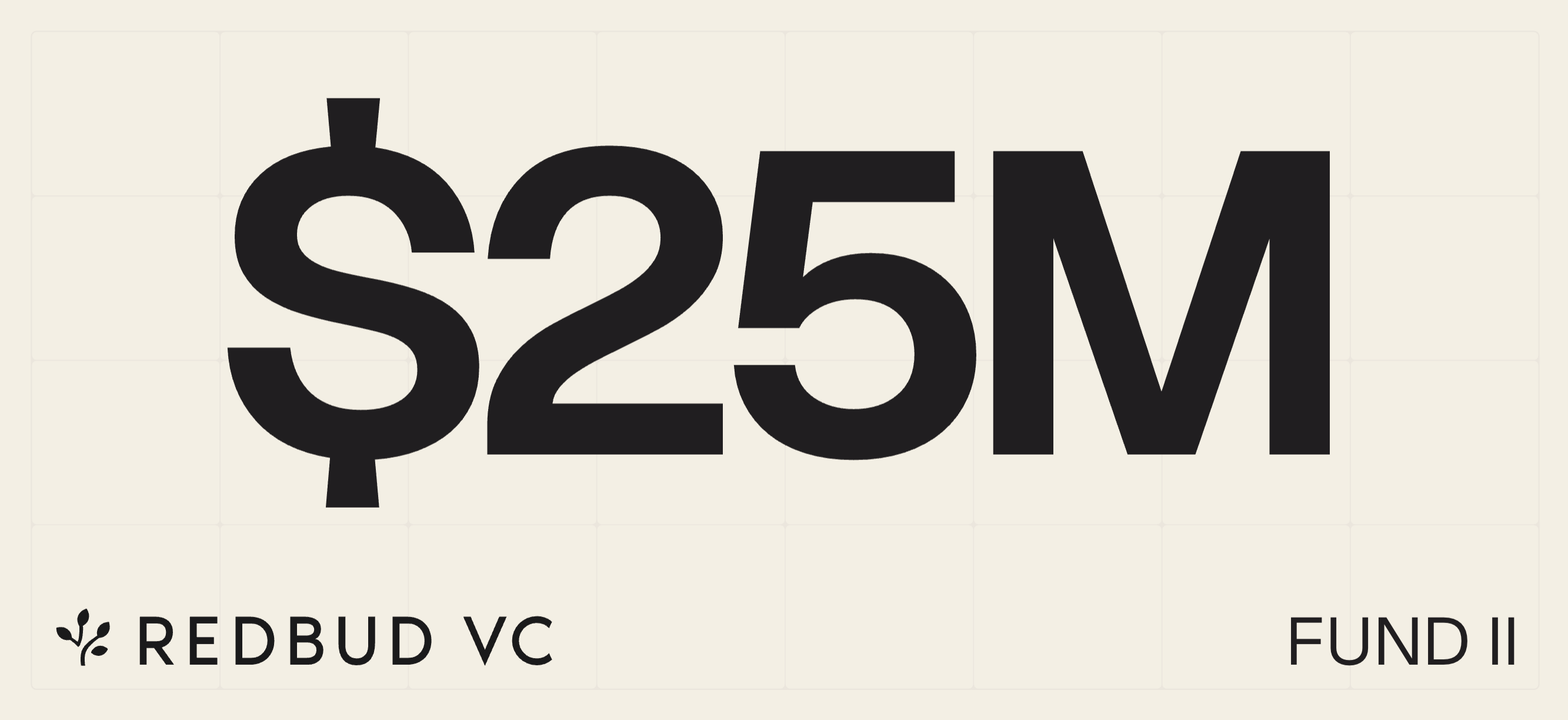
Redbud VC has closed a $25 million Fund II, a 5x step-up from its first fund and its largest raise since the Columbia, Missouri-based firm launched as Scale VC before rebranding. The fund backs "outsider founders" â first-time entrepreneurs, immigrants, and founders from America's Midwest and underrepresented markets who are, in the firm's framing, "strengthened by struggle." The announcement, reported by Axios on March 18, 2026, cements Redbud as the most prominent pre-seed and seed fund operating from the American heartland, with a Fund I track record that is genuinely elite by any benchmark.
Key Takeaways
Fund I performance is the real story here. Redbud's first fund â a $5 million vehicle backing 35 companies â delivered a 48% IRR, 1.7x TVPI, and 21% DPI. For a pre-seed fund of that vintage, those numbers place it in the top decile nationally. The $25M Fund II is not a bet on potential; it is a capital allocation decision by LPs who have already seen the data.
The "outsider founder" thesis is statistically grounded, not just a brand positioning choice. Redbud's Fund I portfolio was 61% first-time entrepreneurs, 45% immigrants, and 48% founders with Midwest roots. The firm argues â and the returns suggest â that these cohorts are systematically undervalued by coastal VCs who pattern-match to Stanford pedigrees and Y Combinator alumni. Redbud is explicitly arbitraging that bias.
The EquipmentShare connection is a genuine differentiator. GPs Willy and Jabbok Schlacks co-founded EquipmentShare, a construction technology company that grew to $4 billion-plus in revenue from Columbia, Missouri. They did not build a company in San Francisco and then move to the Midwest to invest â they built one of the largest privately held tech companies in America from the same geography they are now investing in. That credibility with Midwest founders is earned, not borrowed.
The sourcing model is a volume play that most small funds cannot replicate. Redbud runs approximately 300 LinkedIn outreach messages per week and conducts around 1,500 first founder calls per year. For a $25 million fund, that sourcing intensity is exceptional â and it creates a first-mover advantage in markets where founders have never received a cold outreach from a VC before.
Why This Fund Matters
There is a structural inefficiency in how venture capital is allocated geographically and demographically in the United States. The majority of VC dollars flow to founders in the Bay Area, New York, and Boston â and within those markets, to founders who fit a narrow pattern of prior affiliation with elite universities, major tech companies, or previous venture-backed startups. Redbud's thesis is that this pattern-matching leaves a significant cohort of high-quality founders chronically underfunded, and that first-movers in those markets can generate outsized returns precisely because competition is low.
That thesis was speculative in 2021 when the firm launched as Scale VC. It is empirical in 2026. Fund I's 48% IRR is not a number that requires caveats about small sample sizes or favorable market conditions â 35 companies is a meaningful portfolio, and a 1.7x TVPI with 21% DPI on a pre-seed fund that is only a few years old implies real exits and real markups. The firm has already returned capital to LPs, which is rare for any fund of this vintage at the pre-seed stage.
The $25 million raise also matters in the context of what it signals about Midwest VC as a category. A handful of firms â Drive Capital in Columbus, Revolution in Washington, Redbud in Columbia â have spent the last decade arguing that flyover country is not a liability for venture investing. Redbud's Fund II institutional momentum is evidence that LPs increasingly agree, and that the capital gap between the coasts and the interior of America is narrowing in a measurable way.
For the founders Redbud targets, the value proposition is also material beyond just capital. The firm provides structured mentorship, systematic co-investor introductions, and hands-on operator support from GPs who built a $4B+ revenue company themselves. In a market segment where most founders have never had a warm introduction to a Series A investor, that network access compounds the dollar value of the check significantly.
The Team
Brett Calhoun is the Managing General Partner and the public face of Redbud's sourcing operation. Named to the Forbes 30 Under 30 Venture Capital list in 2024, Calhoun has built the firm's outreach machine and is responsible for much of the deal flow volume that makes Redbud's model work at scale. His background is in finance and business development rather than founding â which makes him an unusual archetype for a GP whose thesis centers on founder empathy, but one whose approach to sourcing and portfolio construction has clearly worked.
Willy Schlacks and Jabbok Schlacks are the firm's operator anchors. The Schlacks brothers co-founded EquipmentShare, a construction technology and equipment rental platform that grew from Columbia, Missouri to become one of the largest privately held technology companies in the United States, with revenues exceeding $4 billion. Their operating experience â scaling a capital-intensive, operations-heavy business in a non-coastal market â gives them a pattern recognition for the challenges Redbud's portfolio companies face that most coastal VCs simply do not possess. Advisor Jim McKelvey (co-founder of Block/Square), Wade Foster (co-founder of Zapier), and Lori Coulter (co-founder of Summersalt) extend the operator network further.
Early Portfolio
Redbud does not publicly disclose its full portfolio, but Fund I backed 35 companies across sectors including SaaS, AI, PropTech, FinTech, healthcare, legal tech, construction, and hardware. The firm has generated at least one material exit in under two years â an acquisition by a Series A investor â and has established co-investment relationships with Sequoia and Y Combinator, which have invested alongside Redbud in portfolio companies. The diversity of sector coverage reflects the generalist positioning that makes sense when the sourcing thesis is geographic and demographic rather than thesis-driven by vertical.
What This Means for Founders
If you are a first-time founder, an immigrant founder, or a founder building from the Midwest or a secondary American market â and you are raising a pre-seed round of $250K-$500K â Redbud is one of the highest-conviction bets you can make for a first institutional check. The firm is not writing large checks, but it is offering something that matters more at the pre-seed stage: a warm introduction network, structured support from operators who have built at scale, and a track record of following founders into Series A via co-investors like Sequoia.
What Redbud is not optimized for is founders who have already raised a seed round, who are raising above $500K at the pre-seed stage, or who are based in San Francisco and primarily looking to tap coastal VC networks. The firm's thesis is explicitly about backing people that the coastal system has overlooked â if you are already embedded in that system, Redbud's value-add is less differentiated. Reach out to Brett Calhoun on LinkedIn (he is responsive by design â the outreach machine works in both directions).
Fund Momentum Take
Redbud is one of the most interesting small funds in America right now, and the $25 million Fund II is underwritten by an actual track record rather than a story. The 48% IRR on Fund I is a number that most established funds would be proud of â for a first-time $5 million fund operating from Columbia, Missouri, it is remarkable. The thesis is differentiated, the sourcing model is scalable, and the GP team has earned its operator credibility rather than borrowing it.
The risks are real but manageable. At $25 million, Redbud is still a small fund â and small funds face structural challenges in pro rata rights and follow-on reserves that larger funds do not. As the firm scales into Fund III and beyond, maintaining the sourcing intensity and founder-first culture that drove Fund I's returns while managing a larger portfolio will be the execution challenge to watch.
Our bet: Redbud will be a name that coastal LPs wish they had backed earlier once Fund II matures. The Midwest VC thesis is not a feel-good regional story â it is an alpha-generating arbitrage on systematic market bias. Redbud has the receipts to prove it, and $25 million in Fund II capital to compound the evidence further.
Frequently Asked Questions
What is Redbud VC?
Redbud VC (formerly Scale VC) is a pre-seed and seed stage venture capital firm based in Columbia, Missouri. Founded by the co-founders of EquipmentShare â Willy and Jabbok Schlacks â alongside Managing GP Brett Calhoun, the firm backs "outsider founders" who are first-time entrepreneurs, immigrants, or builders from underrepresented geographies, particularly the American Midwest.
How large is Redbud VC Fund II and how does it compare to Fund I?
Fund II closed at $25 million, making it 5 times the size of Fund I, which was approximately $5 million. Fund I backed 35 companies and delivered a 48% IRR, 1.7x TVPI, and 21% DPI â top-decile performance for its vintage. The Fund II raise reflects LP confidence in that track record.
What types of founders does Redbud VC back?
Redbud invests in founders it describes as "strengthened by struggle" â specifically first-time entrepreneurs (61% of Fund I portfolio), immigrants (45%), and founders with Midwest roots (48%). The firm believes coastal VCs systematically undervalue these cohorts, creating an arbitrage opportunity for early-stage investors willing to source beyond the Bay Area and New York.
What check sizes does Redbud VC write?
Redbud typically writes first checks of $250,000 to $500,000 at the pre-seed and seed stage. The firm emphasizes being the first institutional capital in, with a network of co-investors including Sequoia and Y Combinator for subsequent rounds.
Who are the key people at Redbud VC?
The General Partners are Brett Calhoun (Managing GP, Forbes 30 Under 30 Venture Capital 2024), Willy Schlacks (co-founder of EquipmentShare), and Jabbok Schlacks (co-founder of EquipmentShare). Advisors include Jim McKelvey (Block/Square co-founder), Wade Foster (Zapier co-founder), and Lori Coulter (Summersalt co-founder).
Have a fund closing to announce? Submit your fund here.
Need help raising capital? Check out our Fundraising Advisory services.