Hyperion Launches $35M Fund I to Become the Strategy Partner Deeptech VCs Promised to Be
TL;DR
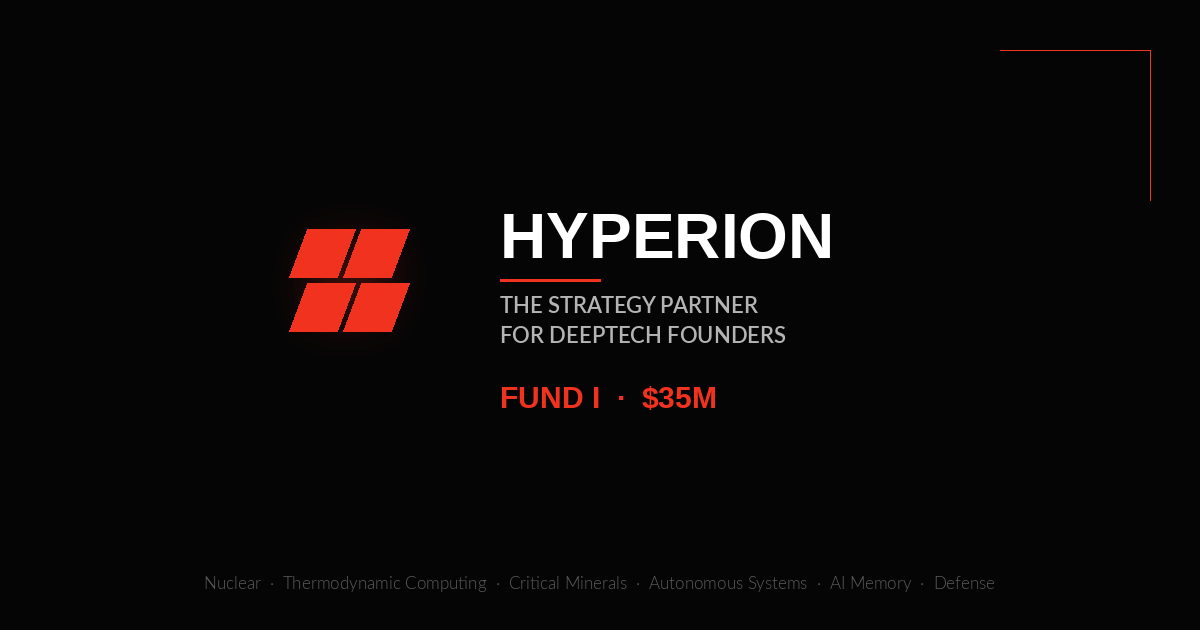
Hyperion, a New York-based investment firm founded by Dillon Dunteman and Henry Bellew, has emerged from stealth with a $35 million Fund I dedicated to being a genuine strategy partner for deeptech founders. The firm has already deployed $9 million across seven companies in its first six months, including early bets on Valar Atomics (now valued at $2B), Antithesis ($105M Series A), and Normal Computing (thermodynamic ASICs). Hyperion's differentiation is research intensity: 100+ pages of deep technical and strategic analysis per investment, delivered directly to founders.
Key Takeaways
The portfolio already validates the thesis at $35M. Hyperion backed Valar Atomics before its $450M Series A at a $2B valuation, got into Antithesis before its $105M Jane Street-led round, and invested in Normal Computing alongside Eric Schmidt's FSV. For a debut $35M fund, hitting three breakout companies in the first six months is an exceptional hit rate that suggests real deal access and technical evaluation skill.
100+ pages of research per investment is the actual moat. Most early-stage VCs write a one-page memo and call it diligence. Hyperion produces over 100 pages of deep research and strategy ideas per company, shared directly with founders and LPs. This is not a marketing claim that scales poorly. At 10-15 investments from a $35M fund, it is a defensible process that creates genuine information asymmetry in the deeptech market.
The anti-pedigree positioning is sharp but risky. Dunteman's launch post is a direct challenge to incumbent deeptech VCs, accusing them of passing on frontier technologies with vague "science risk" excuses, overlooking founders outside elite networks, and prioritizing social media over founder value. It is a bold opening salvo that will attract founders who feel underserved, but it also puts a target on Hyperion's back with every future investment decision.
Vista Equity Partners backing adds institutional credibility. Dunteman credits Vista's senior leadership as supporters. Having one of the most disciplined enterprise software PE firms in the world endorse your deeptech venture fund is an unusual signal. It suggests Vista sees Hyperion's rigorous analytical approach as aligned with its own data-driven investment culture.
Fund Overview
Fund Name: Hyperion Ventures I, L.P.
Fund Size: $35,035,000 (SEC Form D/A, February 26, 2026)
Stage: Early-stage (Seed through Series A)
Check Size: ~$1-2M initial (implied from $9M across 7 companies)
Geography: United States
Focus: Deeptech across nuclear energy, advanced computing, critical minerals, autonomous systems, AI infrastructure, and defense
Key LPs: Vista Equity Partners senior leadership (credited), additional LPs undisclosed
Why This Fund Matters
The deeptech venture market has a paradox. More capital than ever is flowing into the category, with fund after fund launching with "deeptech" in the pitch deck. Yet founders building genuinely hard technology companies, the ones working on nuclear reactors, thermodynamic computing, critical mineral extraction, and autonomous guidance systems, consistently report that their VCs do not actually understand their technology or their markets.
Hyperion's thesis attacks this gap directly. The firm argues that most deeptech VCs are pattern-matching on founder pedigree rather than doing the technical work required to evaluate frontier technologies. The result is a market where PhD founders from Stanford and MIT get funded regardless of commercial viability, while technically exceptional founders outside those networks get overlooked.
The 100+ page research approach is Hyperion's answer. By investing deeply in technical and market analysis before writing a check, the firm positions itself to make conviction-driven bets on companies that other VCs pass on due to perceived complexity. The research also becomes a deliverable for founders, essentially free strategy consulting from a team that has done genuine homework on their industry.
At $35 million, this is a small fund by 2026 standards. But that constraint is actually a feature in deeptech investing. Small funds can take concentrated positions in pre-seed and seed rounds where the ownership economics are most favorable, and where the gap between what founders need (deep technical engagement) and what they get (a wire transfer and a LinkedIn post) is widest.
The Team
Dillon Dunteman and Henry Bellew met as undergraduates at Harvard and are described as close friends and college teammates. Their backgrounds are complementary in ways that matter for deeptech investing.
Dunteman brings a finance-first analytical lens honed across multiple institutional platforms. He worked at Vista Equity Partners on structured equity investments in technology-enabled businesses, at Firmament providing tailored equity and debt capital to SMEs with responsibilities spanning deal sourcing through portfolio oversight, and at MPE Partners as a private equity analyst focused on industrials and aerospace and defense. The A&D sector experience is directly relevant to several Hyperion portfolio companies operating in defense-adjacent markets.
Bellew, based in Cambridge, MA, maintains a lower public profile. His background prior to Hyperion was in stealth, and he shares mutual connections with prominent deeptech investors including Gil Dibner of Angular Ventures. The two-person GP structure keeps overhead low and forces concentrated decision-making, which aligns with the firm's thesis of depth over breadth.
Dunteman also publishes Prescience, a Substack focused on deeptech analysis, which serves as both a deal sourcing channel and a public demonstration of the firm's research capabilities.
Early Portfolio
Hyperion deployed $9 million across seven companies in its first six months of operation. The portfolio spans nuclear energy, advanced computing, critical minerals, AI memory architecture, autonomous systems, and defense.
Valar Atomics (Isaiah Taylor) is building high-temperature gas nuclear reactors using TRISO fuel and helium coolant, designed to power AI data centers. The company emerged from stealth in February 2025 with $19M and subsequently raised a $450M Series A at a $2B valuation led by Snowpoint Ventures, with Palmer Luckey and Palantir CTO Shyam Sankar participating.
Antithesis (Will Wilson, ex-FoundationDB) has built an AI-powered deterministic simulation testing platform for complex distributed systems. The company raised a $105M Series A led by Jane Street and counts major trading firms and crypto networks as customers.
Normal Computing (Faris Sbahi, ex-Google Brain / Google X) is developing agentic EDA solutions and thermodynamic ASICs that could reduce AI energy consumption by up to 1000x. The company raised $35M in seed funding from Eric Schmidt's FSV and Samsung Next and unveiled the first-ever thermodynamic computer.
TC Lab (Charlie Cheng) is developing next-generation AI memory architecture using Vertically Layered Thyristor technology, addressing the bottleneck where conventional 2D memory designs cannot keep pace with modern AI workloads.
Kunin (Daniel Rau, Vanderbilt chemical engineering) is building advanced critical minerals processing systems capable of selectively extracting valuable metals like copper, gallium, germanium, vanadium, and scandium from mining waste. Based in Chattanooga, TN.
F-ADA / Falcon Industries (Mike & Joshua) develops autonomous guidance software for unmanned systems, leveraging embodied machine learning and computer vision. Defense and dual-use positioning.
A seventh company remains in stealth, building an autonomous reliability platform for enterprise agents, led by founders Ahmad and Ali.
What This Means for Founders
If you are building a genuinely hard technology company in nuclear, advanced computing, critical minerals, autonomous systems, or defense-adjacent markets, Hyperion is worth a conversation. The fund is particularly interesting for founders who feel underserved by the current deeptech VC landscape, those who have been told their technology is "too complex" or who lack the Stanford-MIT pedigree that opens doors at larger funds.
The value proposition is clear: you get a check plus 100+ pages of industry research and strategy work, ongoing strategy sessions, and LP introductions that can unlock follow-on capital and commercial relationships. At the seed and early Series A stage, that level of engagement from a small, focused fund can be more valuable than a larger check from a generalist who will forget your name after the wire clears.
Fund Momentum Take
Hyperion is doing something genuinely different, and the early results back it up. Three out of seven portfolio companies have already raised massive follow-on rounds (Valar at $2B, Antithesis at $105M Series A, Normal Computing at $35M seed), which means Hyperion's Fund I is likely already sitting on substantial unrealized returns less than a year into deployment. For LP returns, this is an early signal that the research-intensive approach is selecting winners, not just producing paper.
The risk is scale. At $35M, Hyperion can only make 10-15 investments, and the 100+ page research model does not scale linearly with headcount. If Fund I performs as the early portfolio suggests, Fund II will face pressure to grow, and the question becomes whether the research intensity survives at $100M+ or whether Hyperion becomes the kind of fund it is currently criticizing.
Our bet: Hyperion Fund I will be one of the best-performing small deeptech funds of the 2025-2026 vintage. The portfolio quality at this stage is remarkable for a debut vehicle, and the concentrated approach means that even one or two more breakout companies will generate outsized returns. The real test is not Fund I. It is whether Dunteman and Bellew can resist the temptation to raise a $200M Fund II and dilute the very thing that makes them different.
Frequently Asked Questions
What is Hyperion's investment thesis?
Hyperion invests in early-stage deeptech companies across nuclear energy, advanced computing, critical minerals, autonomous systems, AI infrastructure, and defense. The firm differentiates through research intensity, producing 100+ pages of technical and strategic analysis per investment.
How large is Hyperion Fund I?
Hyperion Ventures I, L.P. raised $35,035,000 according to its SEC Form D/A filed on February 26, 2026.
Who founded Hyperion?
Dillon Dunteman and Henry Bellew, both Harvard graduates. Dunteman previously worked at Vista Equity Partners, Firmament, and MPE Partners. The firm is based in New York.
What companies has Hyperion invested in?
The fund has invested in seven companies: Valar Atomics (nuclear reactors), Antithesis (software testing), Normal Computing (thermodynamic ASICs), TC Lab (AI memory), Kunin (critical minerals), F-ADA/Falcon Industries (autonomous guidance), and one stealth company (enterprise agent reliability).
How does Hyperion support its portfolio companies?
Beyond capital, Hyperion provides 100+ pages of deep research and strategy per investment, regular strategy sessions, LP-to-founder introductions for follow-on capital and commercial partnerships, and key connections that unlock new growth vectors.
Have a fund closing to announce? Submit your fund here.
Need help raising capital? Check out our Fundraising Advisory services.